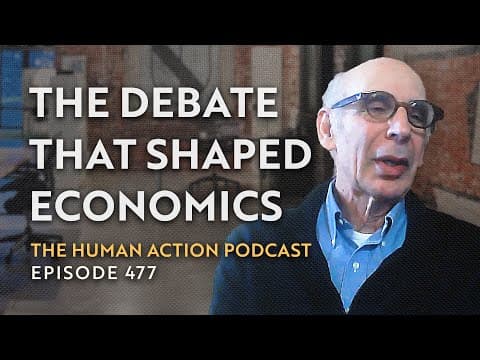
David Glasner discusses his background, the significance of his blog 'Uneasy Money', and delves into the Sraffa-Hayek debate, highlighting the complexities of monetary policy and the critiques of Hayek's theories on interest rates and business cycles.
In this episode of the Human Action podcast, Dr. Bob Murphy engages with economist David Glasner to discuss his insights on the Sraffa-Hayek debate and the implications for monetary policy. Glasner shares his background, the motivations behind his blog "Uneasy Money," and his perspectives on the economic theories of the past century.
David Glasner's journey in economics began at UCLA, where he completed both his undergraduate and graduate studies. After earning his PhD, he served as an assistant professor at Marquette University and later held a visiting position at NYU. His career has included consulting and writing several influential books, including "Politics, Prices, and Petroleum" and "Free Banking and Monetary Reform." He also edited an encyclopedia on business cycles and depressions, which remains a valuable resource today.
Currently, Glasner works at the Federal Trade Commission, although he emphasizes that his views expressed in this podcast are his own and do not reflect the Commission's stance.
Glasner's blog, "Uneasy Money," was launched in 2011, following the financial crisis of 2008-2009. The title reflects his belief that money was not easily accessible during this period, contrary to the prevailing notion of easy money. He draws inspiration from economist Ralph Hawtrey, who warned against the dangers of restoring the gold standard after World War I, predicting that such actions could lead to significant deflation and economic instability.
Glasner argues that the financial crisis was exacerbated by the Federal Reserve's failure to ease monetary policy as the economy entered recession. He believes that the inherent instability of monetary systems, which rely on trust, necessitates careful policy formulation to prevent breakdowns.
The core of the discussion revolves around the Sraffa-Hayek debate, which began in the early 1930s. Piero Sraffa critiqued Friedrich Hayek's theories on the natural rate of interest, which Hayek proposed as a guiding principle for monetary policy. Sraffa argued that the concept of a single natural rate of interest is flawed, particularly in a money economy where multiple commodities exist.
Hayek's argument, as presented in his book "Prices and Production," posited that a central bank should set interest rates in accordance with the natural rate to avoid economic distortions. He believed that an artificially low interest rate could lead to unsustainable economic booms followed by busts.
Sraffa countered that the idea of a natural rate is based on a barter economy, where no money exists. He argued that in a money economy, different commodities would have their own interest rates, making it impossible to identify a singular natural rate. This critique raised significant questions about the validity of Hayek's policy recommendations.
Glasner acknowledges the insights of both Hayek and Sraffa but emphasizes that he aligns more closely with Hayek's views. He believes that while the Austrian theory of business cycles provides a plausible explanation for economic fluctuations, it does not fully encompass the complexities of all business cycles, particularly the Great Depression.
He argues that had the Federal Reserve made better policy decisions during both the Great Depression and the 2008 financial crisis, unemployment could have been significantly lower. Glasner draws parallels between the Fed's preoccupation with stock market speculation in 1929 and its focus on oil prices in 2008, suggesting that these distractions hindered effective monetary policy responses.
The Sraffa-Hayek debate remains a critical discussion in economic theory, highlighting the complexities of monetary policy and the challenges of defining interest rates in a dynamic economy. Glasner's insights provide a nuanced understanding of these issues, encouraging further exploration of the historical context and implications for modern economic policy.
As Glasner concludes, the interplay between different economic theories continues to shape our understanding of business cycles and the role of monetary policy in fostering economic stability.