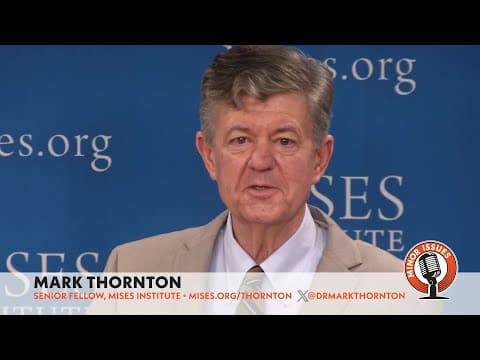
Mark Thornton discusses the significance of Murray Rothbard's work, particularly 'Man, Economy, and State,' highlighting the distinction between natural and normal societal actions, the impact of government intervention, and the theoretical clarity Rothbard brings to economic analysis. Thornton emphasizes Rothbard's typology of intervention and its implications for understanding market dynamics and government policies.
In a recent discussion, Mark Thornton delves into the profound insights of Murray Rothbard, particularly focusing on his seminal work, Man, Economy, and State. This book is often regarded as one of the cornerstones of free market economics in the 20th century. Thornton highlights Rothbard's unique perspective on the distinction between natural human actions and those influenced by government intervention, shedding light on the implications of this divide for economic theory and practice.
Thornton begins by outlining the two primary paths through which individuals arrive at libertarian beliefs. The first path is a natural inclination towards libertarianism, often cultivated from a young age. The second path involves a rigorous examination of societal structures and personal circumstances, requiring critical thinking and sometimes a bit of luck. This duality may explain the relatively small number of libertarians in the world, although Thornton notes a growing interest in libertarian ideas today.
Thornton introduces the concepts of "natural" and "normal" circumstances in human life. He defines natural actions as those that occur without state involvement, while normal actions are those shaped by government intervention. This distinction is crucial for understanding the dynamics of modern society, which Thornton argues is predominantly capitalistic and has led to significant advancements in human welfare. However, he cautions that the state has also expanded its reach, often feeding off the very progress it seeks to regulate.
Murray Rothbard's intellectual journey is likened to a pencil, where his innate talents are the eraser and tip, while his education and experiences form the body. Thornton emphasizes Rothbard's ability to discern the dividing line between natural and normal actions, a skill honed through extensive study of philosophy, economics, and history. This analytical prowess culminated in the development of the libertarian philosophy of anarcho-capitalism.
In Man, Economy, and State, Rothbard elaborates on the free market, presenting it as a self-regulating entity that fosters human cooperation and prosperity. Thornton notes that Rothbard's analysis challenges mainstream economic thought, which often conflates market issues with the need for government intervention. Instead, Rothbard advocates for a clear distinction between market failures caused by government actions and those that arise in a truly free market.
Rothbard's typology of intervention is a significant contribution to economic analysis. He categorizes interventions into three types:
This classification helps clarify the mechanisms through which government actions disrupt market processes and create inefficiencies.
Thornton discusses Rothbard's assertion that government intervention often leads to monopolistic practices and economic distortions. He emphasizes that interventions do not merely shift burdens but can destroy value and create chaos in the market. Rothbard's analysis reveals that government spending does not inherently produce value, as it is detached from consumer preferences and market signals.
Rothbard's insights into taxation are particularly noteworthy. He argues that taxation is not a neutral act; rather, it distorts economic behavior and leads to inefficiencies. The burden of taxation often falls disproportionately on labor and resource owners, resulting in idle resources and higher prices. Thornton highlights Rothbard's critique of the notion of neutral taxation, asserting that the overall level of taxation is what truly matters for economic health.
Thornton points out that Rothbard challenges the idea that government can effectively manage economic resources like a business. He argues that government operations are fundamentally flawed due to the lack of true market feedback, leading to calculational chaos. This chaos manifests in various forms, including price controls and subsidies, which Rothbard argues ultimately harm both consumers and producers.
Mark Thornton's exploration of Murray Rothbard's Man, Economy, and State provides valuable insights into the nature of government intervention and its effects on the economy. By distinguishing between natural and normal actions, Rothbard offers a framework for understanding the complexities of market dynamics and the consequences of state involvement. Thornton encourages readers to engage with Rothbard's work, emphasizing its relevance in contemporary discussions about economic policy and the role of government in society.
In the words of Lou Rockwell, understanding Rothbard's classifications of government interference equips individuals to effectively argue in favor of free market principles. Thornton's analysis serves as a reminder of the enduring significance of Rothbard's contributions to economic thought and libertarian philosophy.