The human mind is a unique, complex inner universe shaped by evolution and social interaction. From simple neural networks in worms to sophisticated minds in bees, octopuses, and birds, minds evolved to process sensory input and control movement. Humans uniquely simulate other minds, enabling morality, storytelling, and large societies. Our minds are collaborative creations influenced by countless others.
You exist in a truly secret place: your mind. This is the totality of your inner world, the location of your consciousness, memories, intelligence, thoughts, emotions, and desires. It is where you think, learn, dream, and imagine, both consciously and unconsciously. Your mind is uniquely yours, a universe only you can access and inhabit.
But how do minds differ? When you imagine an apple, what do you see? A detailed image, a vague shape, or perhaps just a feeling? Do you have an inner voice narrating your thoughts, or is your mind silent? These variations highlight the diversity of human inner experiences.
Humans have some of the most complex minds on Earth, but minds are not exclusive to us. Trillions of animal minds exist, each a secret universe locked away from us. Studying these minds and their evolution helps us understand why human minds are so remarkable.
Minds likely evolved initially to control movement, creating a gap between sensory input and motor output. Early life forms were simple cells that reacted automatically to stimuli, such as moving toward food when hungry. As life became more complex and multicellular, cells specialized in processing information, leading to the emergence of simple minds.
For example, roundworms with just 302 neurons can learn and remember simple things temporarily. These early minds probably do not reason but follow simple rules suited to their environment.
With more neurons, animals can pause before acting, process information, and make decisions. Bees, with about one million neurons, build and remember extensive mental maps of flowers and navigate using the sun. They can take shortcuts and teach others the location of food through dance, indicating complex internal navigation beyond reflexes.
Minds have evolved multiple times in different ways, adapting to the niches animals fill.
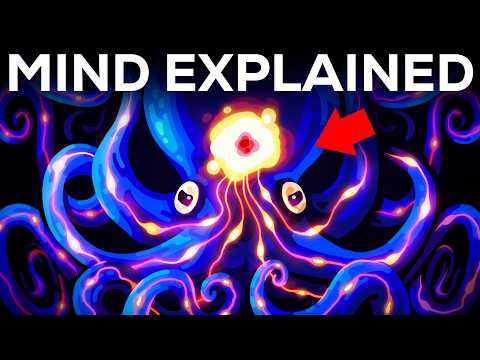
Octopuses have about 500 million neurons, with only 40% in their central brain. Each arm has its own nerve centers capable of processing information and acting independently to some extent. This distributed nervous system allows complex behaviors like coordinated prey capture. The octopus mind raises questions about how consciousness and experience are distributed across its body.
Birds with billions of neurons, such as scrub jays, demonstrate sophisticated minds. They remember where they hide food, track time to avoid spoiled items, and may simulate other birds' minds to protect their caches from theft. This ability to simulate others' minds is a step beyond simple reaction.
Humans, with approximately 86 billion neurons, have taken mind simulation to extraordinary levels. Around 18 to 24 months of age, babies recognize themselves in mirrors, realizing they are separate entities observed by others. This awareness leads to understanding that others have minds that observe and judge us.
Humans simulate not only other minds but also what others think about our thoughts, creating layers of mental simulation. This capacity likely underpins moral conscience and enables large societies of unrelated individuals.
Humans do not just remember events; we imagine the thoughts and feelings of others involved, exploring alternative outcomes. We create fictional universes to plan and share experiences, making stories a way to communicate internal simulations.
Through storytelling, we transmit values, morals, and perspectives, shaping our collective consciousness. Our minds are fundamentally social, filled with voices and ideas from countless others. Your thoughts are shaped by stories you have absorbed, making your mind a collaborative creation.
The human mind is a unique, complex, and social inner universe shaped by evolution and interaction with others. From simple neural networks in early animals to the sophisticated mental simulations of humans, minds have evolved to process information, control behavior, and connect socially. Understanding this helps us appreciate the profound nature of our consciousness and the shared stories that bind us.