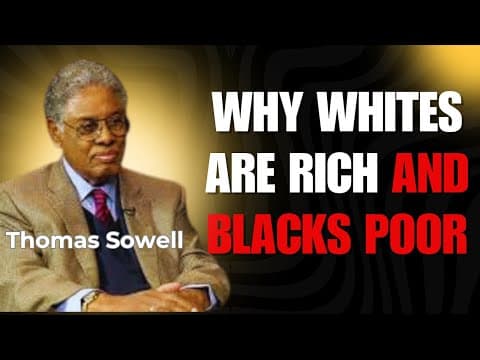
In a revealing discussion, Thomas Sowell and his guest explore the persistent wealth gap between whites and blacks, challenging common stereotypes and examining historical, cultural, and economic factors that contribute to this disparity. They emphasize the importance of understanding opportunity versus outcomes and the role of geography in economic development.
The wealth gap between whites and blacks is a persistent issue that has sparked numerous debates and discussions. In a recent interview, economist Thomas Sowell and his guest delve into this complex topic, challenging stereotypes and uncovering historical truths that contribute to economic disparities. This conversation not only sheds light on the reasons behind the wealth gap but also offers actionable insights for fostering economic equity.
Sowell begins by addressing a fundamental misconception about economic disparities. He argues that many people view income inequities as something that requires a significant explanation, often assuming that without intervention, everyone would have roughly equal incomes. However, he points out that the production of income varies enormously across different groups, nations, and even geographical locations. This variation is a crucial factor in understanding why wealth is distributed unevenly.
One of the key themes in Sowell's discussion is the impact of geography on economic development. He explains that geographical factors can create significant obstacles to wealth creation. For instance, the majority of tornadoes occur in the central United States, while other regions, such as London or Paris, experience very few. This geographical concentration of natural phenomena illustrates how not all conditions are evenly spread across the globe.
Sowell highlights the differences in river systems between Western and Eastern Europe as another example. Western Europe's rivers often lead to open seas, facilitating trade and commerce, while many rivers in Eastern Europe flow into lakes or inland seas, limiting economic opportunities. This geographical isolation can lead to poverty and backwardness, as communities become cut off from the rest of the world.
The historical context of wealth disparities is also crucial. Sowell notes that prolonged isolation can affect not only economic development but also cognitive abilities. For example, when Europeans arrived in Australia, they found Aboriginal communities living at a stone-age level, having been isolated from technological advancements for centuries. This isolation stifles knowledge transfer and innovation, perpetuating cycles of poverty.
A significant point of contention in the discussion is the confusion between opportunity and outcomes. Sowell argues that many redistributionists mistakenly equate unequal outcomes with unequal opportunities. He uses the analogy of basketball to illustrate this point: while everyone may have the same opportunity to play, not everyone will achieve the same level of success. This distinction is vital in understanding the complexities of economic disparities.
Sowell emphasizes that income inequality does not inherently indicate a failure of opportunity. Instead, factors such as credit scores and personal circumstances play a significant role in determining access to resources and opportunities.
The conversation between Sowell and his guest encourages a shift in perspective regarding the wealth gap. Rather than pointing fingers or attributing blame, they advocate for a deeper understanding of the historical, cultural, and economic factors at play. By recognizing the complexities of wealth distribution, society can begin to foster real progress toward economic equity.
This enlightening discussion with Thomas Sowell challenges preconceived notions about race, wealth, and opportunity. By unpacking the historical and geographical factors that contribute to the wealth gap, Sowell and his guest provide valuable insights into how we can address these disparities. As we continue to explore solutions for creating more equitable opportunities, it is essential to keep the dialogue alive and engage in thoughtful discussions about the underlying issues that perpetuate economic inequality.