Recent advancements in fire physics simulation have overcome previous limitations by accurately modeling the interaction between fire and water. This chemically rigorous simulation accounts for different fuel types, oxygen levels, and water sprays, enabling realistic extinguishing of fires in real time. Such technology promises transformative applications in fire safety training and disaster prevention.
Fire simulation has long been a fascinating yet challenging area in computer graphics and physics modeling. While previous works have demonstrated the ability to simulate fires—such as setting a virtual tree ablaze or modeling wildfires—the critical aspect of extinguishing fires realistically remained elusive. Traditional simulations often treated fire like a visual effect, ignoring the complex chemical and physical interactions involved in putting out flames.
Most existing fire simulations resemble those seen in video games: visually convincing but physically inaccurate. For example, throwing water on a simulated fire often results in the water simply passing through the flames without any effect. This limitation severely restricts the usefulness of such simulations, especially for applications like firefighter training, where realistic interaction with fire and extinguishing agents is crucial.
A recent research breakthrough addresses this problem by introducing a chemically rigorous simulation that models fire, fuel, oxygen, and water sources within a given geometry. This simulation can:
The simulation distinguishes between laminar water flow and spray:
This distinction explains why a spray is far more effective at putting out fires than a solid stream.
While the visual rendering is not state-of-the-art, the simulation excels in chemical accuracy. For instance:
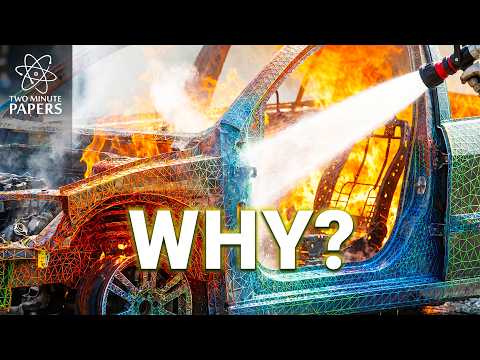
The simulation can handle multi-phase experiments involving solids, liquids, and gases interacting simultaneously. For example, in a scenario with burning cars:
One compelling demonstration involves a kitchen fire:
This capability allows for virtual safety labs where millions of "what if" scenarios can be tested without real-world risks, optimizing sprinkler placement and response times.
The key innovation lies in bridging two previously incompatible simulation methods:
Previously, these two systems could not interact effectively, causing water particles to pass through fire grids unrealistically. The new research introduces a high-speed translator that enables real-time communication between the grid and particle systems.
When a water droplet contacts a hot spot, it absorbs heat, turning into steam, which then suffocates the fire by displacing oxygen. This interaction is governed by the Arrhenius equation, which controls the fuel burn rate based on temperature and oxygen availability. Even a small temperature drop caused by water can halt the chemical reaction, effectively extinguishing the fire.
The simulation's findings offer valuable metaphors for problem-solving:
Currently, the simulation assumes static solid geometry, limiting dynamic elements like elastic trees. However, this tradeoff is acceptable given the complexity of the simulation. The research is ongoing, and future developments may enable simulations of entire cities, vastly expanding the technology's utility.
This revolutionary fire physics simulation represents a major leap forward in accurately modeling fire behavior and extinguishing processes in real time. Beyond gaming and visualization, it holds immense potential for fire safety training, disaster prevention, and scientific research. As the technology evolves, it promises to transform how we understand and interact with fire in virtual and real environments.
This article is based on insights from recent research and expert commentary on advanced fire simulation techniques.