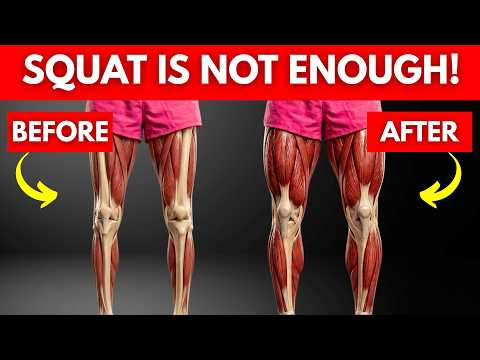
Many over 50 struggle with leg strength due to imbalances caused by traditional squats focusing mainly on quads. This article presents five targeted exercises plus a bonus move that activate neglected muscles like glutes, hamstrings, calves, and tibialis, restoring up to 80% of lost leg strength in three weeks without squats or machines. Detailed instructions and progressions ensure safe, effective training for lasting strength and balance.
Many people over 50 find themselves stuck in a trap where traditional squats, often recommended for stronger legs, fail to deliver the desired results. Despite consistent effort, quads may remain flat, hamstrings weak, and glutes barely activate. This is not due to laziness or age winning, but because standard squats primarily target the quads, leaving hamstrings, adductors, and deep stabilizing glute fibers underworked. This imbalance can lead to loss of strength, balance, and power.
This article introduces five precise movements designed to awaken the muscles that squats often ignore, helping restore up to 80% of lost leg strength in just three weeks. These exercises require no squats, machines, or heavy knee strain.
Most leg training focuses on forward and backward movements, but daily life involves stepping sideways, catching yourself when stumbling, and shifting weight to avoid falls. The lateral step-up trains this essential side-to-side pattern.
It activates the gluteus medius, which keeps hips level and knees tracking straight, and the gluteus maximus, the powerhouse behind strong strides. This combination improves movement, steadiness, and builds rounder, fuller glutes.
Many treat this like a regular step-up and rush the movement. The key benefit lies in the slow, controlled lowering (eccentric phase), which strengthens stabilizers. Rushing this phase wastes about 70% of the benefit.
If balance is challenging, lightly rest a fingertip on a wall, aiming to reduce reliance over time.
This exercise loads one leg at a time, revealing strength imbalances and building serious strength. With the back foot elevated, the front leg does most of the work, engaging quads, glutes, and hamstrings while challenging stabilizers.
It mimics a heavy squat without the need for a barbell or knee strain.
Incorrect front foot placement leads to knees passing toes or loss of drive, reducing glute and hamstring engagement.
If balance is difficult, hold a wall or chair lightly. Adjust range or lean as needed but do not skip this exercise.
Sitting all day often shuts off the glutes, causing lower back and hamstring strain. This exercise reactivates the glutes, which power every step and movement.
Elevating the feet extends the range of motion and shifts load onto glutes and hamstrings without straining the spine.
Pushing through the lower back or letting heels drift too far turns this into a hamstring cramp or backache.
If hamstrings cramp, bring feet closer to hips and focus on glute squeeze.
Calves are crucial for balance and absorbing impact. Weak calves reduce balance and the spring in your stride.
Deficit calf raises train calves through a full range, including a deep stretch below the toes, building strength and resilience.
Bouncing and skipping the bottom stretch wastes the exercise's benefits.
If Achilles is sensitive, shorten range and allow gradual adaptation.
This simple exercise builds grip strength, core, traps, forearms, and legs while teaching full-body stability under load.
Grip strength is a strong predictor of longevity and independence.
Allowing shoulders to round and posture to collapse under weight turns this into a back strain.
No weights? Use loaded backpacks or grocery bags.
The tibialis anterior muscle on the front of the shin is often neglected but essential for lifting toes during walking. Weakness causes foot drag, leading to trips and falls.
Strengthening this muscle balances calf strength and reduces knee and shin pain.
Using the whole leg instead of isolating the shin muscle.
If you can't feel it, slow down the movement further.
These five main exercises plus the bonus tibialis raise target all the critical muscles for leg strength, balance, and functional movement after 50. They address common weaknesses caused by traditional squats and sedentary lifestyles.
By committing to this plan for three weeks, you can rebuild glute activation, single-leg power, calf strength, grip, and shin control, leading to stronger, steadier legs and a body built to last.
The key difference between those who rebuild their legs and those who only wish is starting and staying consistent.
Start today, follow the progressions, and feel the difference by week three. Your strongest decades are ahead, built on the foundation you lay now.