The global economy is facing an unprecedented collapse, driven by government failures, rising inflation, and a weakening rupee. As political leaders resign and economic indicators worsen, ordinary citizens bear the brunt of a system that prioritizes the wealthy over the majority. This blog post explores the mechanisms behind this crisis and its implications for the future.
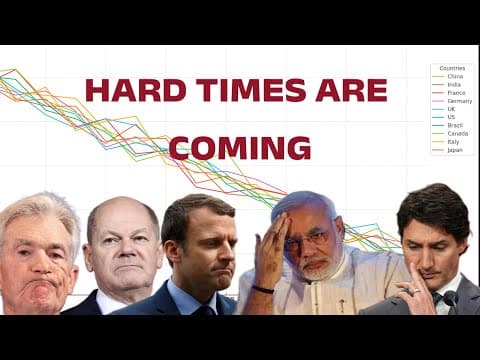
The global economy stands on the brink of an unprecedented collapse, with warning signs that are no longer whispers but deafening alarms. Governments worldwide are teetering on the edge of failure, as financial ministers resign in droves under the unbearable weight of their responsibilities. The carefully crafted facade of economic stability is crumbling, revealing a catastrophic reality that threatens the savings, jobs, and futures of ordinary people.
In Canada, Finance Minister Chrystia Freeland recently resigned amid a storm of political and economic turmoil. Prime Minister Justin Trudeau's administration, which has painted a picture of economic strength, faces widespread backlash. Behind this facade lies an unemployment rate near 7%, the highest outside of pandemic times, and a stalled GDP growth rate. Canadians are watching their purchasing power evaporate while the government insists that inflation is under control.
Germany and France are no better off. Chancellor Olaf Scholz's government in Germany has collapsed under the weight of no confidence votes, while Emmanuel Macron in France has cycled through four Prime Ministers in just over a year. Political instability and economic mismanagement have driven approval ratings to historic lows. These governments blame political opposition and external shocks for their failures, but the truth is simpler: their policies have deepened the economic malaise they were elected to solve.
Central banks have become willing accomplices in the deception, creating the illusion of recovery through monetary gimmicks like quantitative easing and rate cuts. However, as the real economy deteriorates, these illusions are shattering, leaving behind a populace that is poorer, angrier, and increasingly aware of the betrayal.
In the United States, Federal Reserve Chair Jerome Powell's recent rate cuts have been accompanied by promises of economic expansion and controlled inflation. Yet, the dollar's relentless rise wreaks havoc on global currencies, tightening financial conditions to the point where a full-blown currency crisis is imminent. Quantitative easing, intended to stimulate economic activity, has instead inflated asset prices, benefiting the wealthy while doing little for the real economy.
Inflation is one of the most visible signs of economic distress. Governments manipulate inflation statistics to downplay the crisis, while the relentless rise in prices for essentials like food, fuel, and housing leaves millions poorer. In India, inflation is compounded by a weakening rupee, driving up the cost of living and forcing families to spend more on basic necessities.
Unemployment is a key indicator of economic distress, and in India, job creation has collapsed as businesses cut back on hiring due to uncertainty. Rural agricultural workers migrate to cities only to find non-existent opportunities, exacerbating overcrowding and straining public resources. A recent report revealed that the richest 10% of Indians control 77% of the wealth, leaving the rest to scramble for scraps.
Debt is a silent killer in today's economic crisis, particularly in emerging markets like India. Years of low interest rates encouraged heavy borrowing, but as global financial conditions tighten, servicing dollar-denominated debt becomes unsustainable. India's credit growth has plummeted, signaling a credit crunch that grinds economic activity to a halt.
The impact of these policies is measured not in statistics but in lives. Urban workers face skyrocketing rents and stagnant wages, while middle-class families dip into savings just to cover basic expenses. The government's regressive taxation policies compound this suffering, as the rich grow richer while the poor are abandoned.
The stock market is often celebrated as a barometer of economic health, but in India, it has become a mirage that hides deeper economic failures. Many highly anticipated IPOs have seen catastrophic declines, erasing billions in investor wealth and disproportionately affecting retail investors. This speculative growth does not reflect a healthy economy but rather a system rigged against ordinary citizens.
The rupee's relentless fall against the dollar is not merely an economic concern; it is a daily struggle for average Indians. Essential imports have seen price surges, contributing to a retail inflation rate persistently above the RBI's target range. This erosion of purchasing power creates a cascading effect, reducing consumption and further weakening the economic fabric.
As the illusions fade, the grim reality becomes clear: the global economy is heading into a depression, with catastrophic fallout. Emerging markets will face currency collapses and defaults on dollar-denominated debt, while advanced economies will see rising unemployment and weakened manufacturing.
In India, the government's attempts to spin this as a temporary setback will fail as ordinary citizens witness their savings wiped out and opportunities disappear. The political fallout will be severe, but the economic damage will be even greater. A generation will be left to pick up the pieces of a broken system that failed them at every turn.
The global financial system has been exposed as a house of cards, with ordinary people bearing the brunt of the failures of governments and central banks. The coming months will reveal the full extent of the damage, and it will be the people, not the policymakers or bankers, who will pay the price. This is the grim reality of the world we live in, demanding not just acknowledgment but action. The storm is here, and there is no escape.