Overthinking stems from an overactive default mode network in the brain, which becomes harder to regulate with age. A specific ancient breathing technique called Nadi Shodhana, involving alternating nostril breathing with a 4:8 inhale-exhale ratio, can shift the nervous system from sympathetic arousal to parasympathetic calm within 90 seconds. Regular practice rewires the brain to reduce overthinking and improve stress response.
Overthinking is a common experience, especially during moments of rest or stress, such as late at night or before important meetings. But what if you could silence this relentless mental chatter in just 90 seconds? This article explores the neuroscience behind overthinking and introduces a specific ancient breathing protocol that can calm your mind quickly and effectively.
Overthinking is not simply a personality trait; it is the result of an overactive default mode network (DMN) in the brain running without proper inhibition. The DMN is a real brain structure comprising the medial prefrontal cortex, posterior cingulate cortex, and angular gyrus. It activates when you are not focused on a task and generates the internal monologue that loops through past regrets, future worries, and self-referential thoughts.
Normally, the prefrontal cortex suppresses this network when focus is required. However, after the age of 45, the volume of the prefrontal cortex decreases, cortisol rhythms become dysregulated, and vagal tone declines. These three factors weaken the brain's ability to inhibit the DMN, making overthinking more persistent and harder to control.
Your breathing pattern significantly influences your nervous system state. Shallow, fast chest breathing keeps the sympathetic nervous system (the body's stress response) activated, which fuels the overthinking loop. This breathing pattern signals threat to the body, maintaining the brain in a heightened state of alertness.
Conversely, slow breathing at about six breaths per minute increases heart rate variability (HRV) and activates the parasympathetic nervous system, which calms the body and interrupts the stress response.
Dating back approximately 3,000 years, the yoga sutras documented a specific breathing technique known as Nadi Shodhana or alternating nostril breathing. Neuroscience has since confirmed why this practice works so effectively:
Nasal Cycle and Brain Hemisphere Activity: You do not breathe equally through both nostrils; one nostril leads and switches every 90 to 120 minutes. Left nostril dominance correlates with right hemisphere activity and parasympathetic bias, while right nostril dominance correlates with left hemisphere activity and sympathetic bias.
Balancing Brain Hemispheres: Nadi Shodhana forces air through both nostrils in sequence, engaging both hemispheres and balancing brain activity. This balance reduces the dominant signal of the DMN, quieting the overthinking loop.
Nasal Breathing and Nitric Oxide: Nasal breathing generates nitric oxide in the paranasal sinuses, which dilates blood vessels and improves oxygen delivery to the brain. Mouth breathing produces almost none of this molecule and does not calm the system effectively.
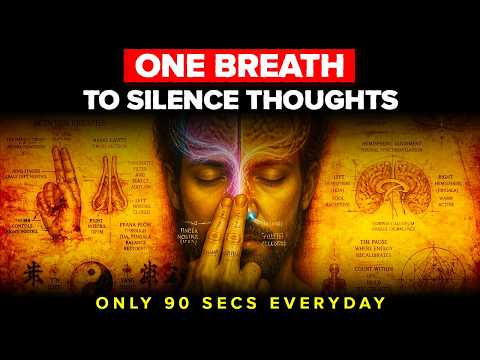
Breath Ratio: The protocol uses a 4-count inhale and an 8-count exhale through alternating nostrils. The extended exhale stimulates the vagus nerve, triggering the parasympathetic nervous system and lowering heart rate.
You do not need special equipment or a specific setting. Here is the step-by-step protocol:
Hand Position (Vishnu Mudra): Use your right hand, folding your index and middle fingers down. Your thumb controls the right nostril, and your ring finger controls the left.
Starting Position: Close your right nostril with your thumb.
Inhale: Breathe in slowly through your left nostril for a count of four.
Hold: Close both nostrils and hold your breath for one count.
Exhale: Release your right nostril and exhale slowly for a count of eight.
Inhale: Inhale through your right nostril for four counts.
Switch: Close your right nostril and exhale through your left nostril for eight counts.
This completes one round. Repeat for three rounds, which takes approximately 90 seconds.
The extended exhale stimulates the vagus nerve, which lowers heart rate and reduces sympathetic arousal. This shift creates a chemical environment in the brain where the DMN quiets down, interrupting the overthinking loop.
Studies show that structured breathing with extended exhales produces greater reductions in physiological arousal and anxiety than mindfulness meditation over a month of daily practice.
Day 1: The suppression of overthinking is real but temporary. You will notice a quieter mind and increased HRV during and shortly after practice.
Day 7: The parasympathetic response arrives faster, even during real-life stressors like emails or traffic. You gain a half-second delay in reaction time, allowing you to choose your response.
Day 21: A noticeable shift occurs where the pause between trigger and reaction widens naturally. Sleep improves, mornings feel less tense, and you can consciously stop spiraling thoughts.
Day 90: The practice becomes part of your identity. You respond to stress differently, not just in mood but in autonomic function. The overthinking network still produces thoughts, but you no longer follow each one into a spiral.
Initially, calming down requires effort and conscious practice. Over time, the lateral prefrontal cortex learns to regulate the amygdala with less effort, making calmness a default state rather than a forced one. This neural pathway is strengthened through repetition.
Many people try breathwork once and quit because they expect dramatic sensations and dismiss the subtle but real physiological changes. The key is consistent repetition over weeks and months to rebuild the nervous system's regulation.
This ancient breathing technique offers a powerful, free, and accessible tool to quiet an overthinking mind in just 90 seconds. It works by balancing brain hemispheres, stimulating the vagus nerve, and shifting the nervous system from stress to calm. With regular practice, it rewires your brain to respond to stress differently, improving mental clarity and emotional resilience.
Tonight, when your mind starts to spiral, you now have a scientifically backed method to regain control. The only question is whether you will take the next 90 seconds to breathe.
If you have tried breathwork before without success, consider what might have been missing in the mechanism. Share your experiences and when your overthinking hits hardest—morning, late night, or during conversations—in the comments. Understanding your pattern is the first step toward change.