This article explores the importance of self-imposed limitations in personal development, using the metaphor of Batman's ethical framework to illustrate how setting rules can enhance decision-making and foster growth.
In today's fast-paced world, many individuals struggle with the chaos of modern life, often making decisions based solely on emotion and self-interest. Dr. Orion Terban discusses the significance of self-imposed limitations and how they can serve as an ethical framework for personal development. This framework not only helps individuals navigate life's complexities but also encourages them to become better versions of themselves.
When we talk about limitations in this context, we refer to a self-imposed, extrapolated ethical framework. This framework is self-imposed because it requires personal commitment, and extrapolated because it necessitates deep reflection on one's values and beliefs. An ethical framework informs decision-making and helps individuals maintain consistency in their actions.
Many people today have not committed to a specific philosophical or religious framework, leading to a chaotic existence where moral standards shift frequently. This inconsistency can be mentally exhausting and can hinder personal growth. By adopting a comprehensive ethical framework, individuals can establish a guiding principle that acts as a North Star, helping them navigate the ambiguities of life.
One of the primary benefits of having an ethical framework is that it helps prevent self-destructive behavior, especially when one achieves success. When individuals reach a point where they can do whatever they want, the absence of self-imposed limitations can lead to chaos. For instance, many celebrities and rock stars have faced significant challenges when they gained the freedom to act without restrictions. By establishing limitations early on, individuals can prepare themselves for future success and avoid the pitfalls that often accompany it.
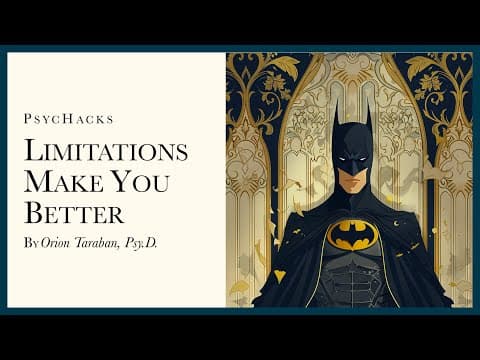
To illustrate the importance of self-imposed limitations, Dr. Terban uses the character of Batman. Bruce Wayne, as Batman, operates under a set of self-imposed rules that distinguish him from his nemesis, the Joker. These rules, such as not using guns or killing, are not enforced by anyone else but are crucial for maintaining Batman's moral integrity.
If Batman were to abandon these rules, he would lose his ethical foundation and become indistinguishable from the Joker. This highlights the importance of self-imposed limitations: they create a structure that fosters personal growth and accountability. Without these limitations, individuals risk descending into chaos, losing their sense of self and purpose.
The limitations that Batman imposes on himself also serve as a catalyst for improvement. Because he has fewer win conditions than the Joker, Batman must become stronger, smarter, and more skilled to compete effectively. This necessity for improvement is a direct result of the limitations he has chosen to adopt.
Dr. Terban encourages individuals to define their own "Batman rules"—the limitations they choose to apply to their lives. These rules should not be seen as punitive but rather as a means to foster personal growth. By consciously setting limitations, individuals can challenge themselves to become better and more disciplined.
In conclusion, self-imposed limitations are essential for personal development. They provide a framework for ethical decision-making and help individuals navigate the complexities of life. By adopting a set of personal rules, much like Batman, individuals can enhance their skills and ensure they do not lose their way in the face of success. As you reflect on your own life, consider what limitations you can impose to foster your growth and integrity. What are your Batman rules?