This article explores the groundbreaking Aharonov-Bohm effect, which challenged classical physics by demonstrating that electromagnetic potentials can influence quantum particles even in regions with zero magnetic and electric fields. It traces the history from the three-body problem and Lagrange's potentials to the quantum experiments that reshaped our understanding of magnetism and potentials' physical reality.
Imagine you are in empty space and fire off a stream of electrons. According to most physics textbooks, the only way to change how those electrons behave is by applying an electric, magnetic, or gravitational force to them. But most physics textbooks are wrong.
In the 1950s, two physicists, David Bohm and Yakir Aharonov, proposed a clever experiment. They suggested that electrons could travel through a region with no electric or magnetic fields whatsoever, yet by flipping a switch, you could change their behavior. The magnetic field could be zero, but the presence of some quantity—the magnetic vector potential—could lead to observable effects. This was unexpected and split the physics community, challenging the notion that fields are fundamental and potentials are mere mathematical tools.
The story begins with one of the hardest problems in physics: the three-body problem. While the two-body problem was solved by Newton over 300 years ago, adding a third body made the system chaotic and unpredictable due to the complex vector forces involved.
Joseph-Louis Lagrange, in the 1770s, introduced the concept of gravitational potential (V), a scalar field representing the gravitational influence of a body. This scalar potential simplifies calculations by allowing the addition of potentials rather than vectors. Lagrange also identified points in space (now called Lagrange points) where a small third body could maintain a stable orbit due to zero net force.
Lagrange further developed mechanics using kinetic and potential energy to form the Lagrangian, which simplifies solving complex mechanical systems like the double pendulum.
Following gravitational potentials, physicists sought similar potentials for electric and magnetic forces. Electric potentials were easier to define since electric forces can attract or repel, creating potential hills and wells.
Magnetism, however, was more challenging. Magnetic field lines form closed loops without a beginning or end, unlike electric fields. William Thomson (Lord Kelvin) introduced the concept of the magnetic vector potential (A) and the mathematical operation called the curl to describe magnetic fields as the curl of A.
Potentials became essential tools in physics, often preferred over forces or fields for problem-solving. However, most physicists considered potentials as mathematical conveniences without direct physical significance because potentials can be shifted by arbitrary constants without changing observable forces.
Quantum mechanics describes particles as waves governed by the Schrödinger equation. The wave function's phase is influenced by potentials, not just fields. Aharonov and Bohm realized that the magnetic vector potential appears directly in the Schrödinger equation, suggesting potentials might have physical effects even where fields vanish.
They proposed an experiment where electrons pass around a solenoid with a confined magnetic field inside but zero magnetic field outside. Classical physics predicted no effect on electrons outside the solenoid, but if potentials influence quantum phases, the interference pattern of electron waves should shift.
The experiment involves splitting an electron beam into two paths around a solenoid. When the solenoid is off, the interference pattern is stable. When turned on, despite zero magnetic field outside, the interference pattern shifts due to the magnetic vector potential affecting the electron wave phases.
Early experiments by Robert Chambers used a tiny magnetized iron whisker to approximate the solenoid, showing the effect but with some skepticism due to possible stray fields.
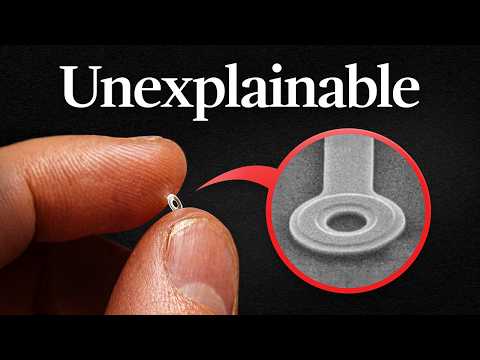
In 1986, Akira Tonomura and his team used a tiny donut-shaped magnet (a torus) coated with superconducting niobium to perfectly confine the magnetic field inside the donut, ensuring zero field outside. They fired a wide electron beam passing partly through and partly around the torus. The resulting interference pattern showed a clear phase shift exactly as predicted by the Aharonov-Bohm effect.
This experiment provided strong evidence that potentials have real physical effects independent of fields.
Physicists are divided into two camps:
Potentials are physically real: Potentials influence reality directly and are more fundamental than fields.
Fields are fundamental but act non-locally: Fields cause the effects even outside their region, implying non-locality.
Aharonov himself shifted towards the second interpretation, suggesting the effect is a non-local influence of fields.
A third interpretation considers quantum particles exploring all possible paths simultaneously, including paths through regions with fields, explaining the effect without abandoning locality.
In 2022, researchers at Stanford tested a gravitational analog of the Aharonov-Bohm effect using ultra-cold rubidium atoms and a tungsten mass. They observed phase shifts consistent with the effect, suggesting gravitational potentials can also influence quantum phases even when gravitational fields are zero.
The Aharonov-Bohm effect reveals that electromagnetic and gravitational potentials can influence quantum particles even in the absence of fields, challenging classical physics and textbooks. This discovery underscores the evolving nature of scientific understanding and the power of individuals to challenge established paradigms.
The story of potentials—from Lagrange's gravitational potential to the quantum vector potential—illustrates the deep and surprising connections between mathematics and physical reality, inviting ongoing exploration and discovery in physics.