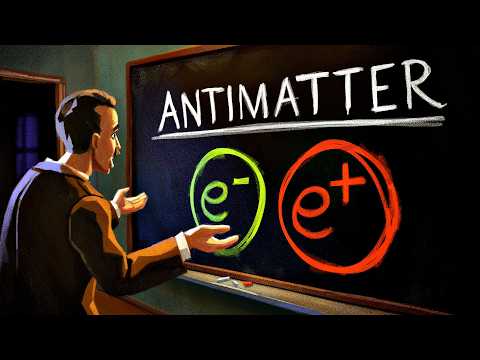
In 1928, a physicist presented a theory revealing particles with negative energy, challenging the foundations of quantum mechanics and relativity. This article explores the historical context, Einstein's special relativity and E=mc², the emergence of quantum mechanics, the Schrödinger equation, and the need for relativistic quantum mechanics to explain phenomena in heavy elements like gold and mercury.
In 1928, a young physicist delivered a lecture in Germany that would profoundly disrupt the world of quantum mechanics. His presentation style was described as detached and technical, lacking any sign of enjoyment. Despite this, the content of his work sent shockwaves through the physics community, leading some of the most famous quantum physicists of the 20th century to question their field.
Werner Heisenberg called the theory "the saddest chapter in modern physics," and even considered abandoning quantum physics. Wolfgang Pauli reportedly left the field to write a utopian novel. What was so unsettling about this young man's work?
The physicist was tackling a problem that remains central to physics today: unifying Einstein's theory of relativity with quantum mechanics. His work revealed the existence of a particle with negative energy, a concept that was troubling and unprecedented.
In 1905, Albert Einstein published his special theory of relativity, based on the principle that the laws of physics are the same for anyone moving at a constant speed, including the speed of light. This led to the realization that time and space are not separate but linked in a four-dimensional fabric called space-time.
Einstein discovered that when an object emits light (photons), it loses energy, and its mass decreases accordingly. This relationship is expressed as the famous equation:
E = mc²
where energy (E) equals mass (m) times the speed of light squared (c²). Einstein described mass and energy as different manifestations of the same thing.
The total energy of a particle comes from its momentum and rest mass, leading to a new relationship between energy and momentum. When solving for energy, the equation yields two solutions: one positive and one negative. However, negative energy solutions were ignored in classical physics because they seemed non-physical.
Around the same time, physicists observed phenomena that classical physics could not explain. Subatomic particles like electrons exhibited discrete energy levels and wave-like behavior, such as interference patterns when passing through two slits.
This led to the development of quantum mechanics, formalized by Erwin Schrödinger in 1926 through his wave equation. The Schrödinger equation describes how quantum systems evolve over time, with the wave function (ψ) providing the probability of finding a particle at a specific location and time.
The Schrödinger equation is derived by expressing the total energy of a free particle as kinetic energy (p²/2m) and applying quantum operators to the wave function. For particles in potential fields, the full Schrödinger equation includes potential energy.
Despite its success, the Schrödinger equation fails to predict certain properties of heavy elements. For example, it predicts that gold should appear silver-gray like other metals, but gold has a distinct color. It also predicts mercury should be solid at room temperature, but mercury is liquid.
These discrepancies arise because heavy elements have many protons, causing electrons to orbit at speeds approaching the speed of light. At these relativistic speeds, the classical kinetic energy expression (p²/2m) is no longer accurate.
To account for relativistic effects, physicists must use the energy-momentum relation from special relativity rather than the classical kinetic energy formula. This leads to more complex equations that incorporate both quantum mechanics and relativity.
The young physicist in 1928, Paul Dirac, developed such an equation, now known as the Dirac equation. His work predicted the existence of particles with negative energy, which was initially troubling but later understood as a fundamental aspect of quantum field theory.
The discovery of negative energy solutions challenged the foundations of physics and forced a re-examination of the relationship between quantum mechanics and relativity. While initially met with skepticism and despair by leading physicists, this work paved the way for modern quantum field theory and a deeper understanding of the universe's fundamental particles and forces.
The journey from Einstein's special relativity and E=mc² to the Schrödinger equation and finally to relativistic quantum mechanics illustrates the evolving nature of scientific understanding and the ongoing quest to unify the laws governing the very large and the very small.
This exploration highlights how a seemingly abstract mathematical solution—negative energy particles—can have profound implications, reshaping physics and expanding our comprehension of reality.