Space debris poses a significant threat to satellites and future missions due to its high-speed movement in crowded orbits. The OMLET project, led by the German Aerospace Center and international partners, is developing a ground-based high-power laser system to alter debris orbits via laser momentum transfer. This innovative approach involves advanced adaptive optics to overcome atmospheric distortion, aiming to prevent collisions and ensure sustainable space operations.
Space is becoming increasingly crowded with remnants of past missions, commonly known as space debris. These fragments travel at incredible speeds and pose a serious threat to operational satellites and future space missions. The loss or malfunction of satellites would severely limit modern communication, navigation, and weather forecasting capabilities, which are integral to daily life and global infrastructure.
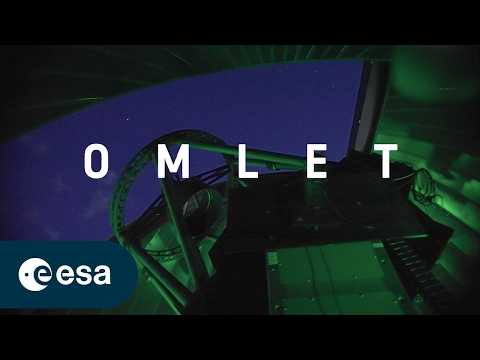
To address this critical issue, the European Space Agency (ESA) has initiated a project called OMLET, which stands for Orbit Maintenance via Laser Momentum Transfer. This project is being developed by a team of international partners led by the Institute of Technical Physics at the German Aerospace Center.
The goal of OMLET is to design a ground-based station capable of launching a high-power laser beam into low Earth orbit. This laser would be used to change the orbit of space debris objects just enough to avoid collisions with satellites or other debris.
By precisely directing a powerful laser beam at a piece of space debris, the object is slightly decelerated. This deceleration causes a small but significant change in the debris's trajectory, allowing it to safely avoid high-risk close approaches with other satellites or debris. This method does not require physical contact or capture of the debris, making it a non-invasive and efficient solution.
The OMLET system integrates several advanced subsystems to function effectively:
At Trump Scientific Lasers in Germany, scientists and engineers are designing a novel laser system to meet the demanding power and beam quality requirements for laser momentum transfer. Simulations indicate that an effective push on space debris requires laser power in the range of 50 kilowatts, which is a tremendous amount of energy.
To achieve this, the approach involves combining multiple lower-power laser units and merging their output beams into a single, high-power beam. This technique allows for scalability and improved beam quality.
Tests conducted at High Lays in the Czech Republic focus on understanding how different materials react to laser beams. This research is crucial to predict how various types of debris will respond to laser momentum transfer.
One of the significant challenges is the Earth's atmosphere, which distorts laser beams and makes precise targeting difficult. To overcome this, OMLET employs a sophisticated adaptive optics system.
Adaptive optics technology is well-known in astronomy, where it is used to correct images of galaxies and other celestial objects by compensating for atmospheric turbulence using a laser guide star. However, OMLET is pioneering the reverse application: sending a light signal from the ground up to space with high precision.
This new concept requires advanced adaptive optics to ensure the laser beam remains focused and accurately directed at fast-moving debris objects in orbit.
OMLET envisions establishing a global network of ground-based stations that can identify debris, track their orbits, and prevent collisions through timely laser interventions. This network would play a vital role in keeping space tidy and supporting future space missions by reducing the risk of debris-related accidents.
The development of OMLET represents a significant step forward in space sustainability. By making space operations safer and more efficient, OMLET has the potential to save money and time for satellite operators and space agencies worldwide.
As one project member stated, the goal is to develop a laser system that can help globally maintain space cleanliness and support the continued growth of space activities.
The OMLET project is at the forefront of research and development aimed at addressing the growing problem of space debris. Through innovative use of high-power lasers and adaptive optics, OMLET offers a promising solution to prevent collisions in orbit, ensuring the safety and sustainability of space operations for years to come.