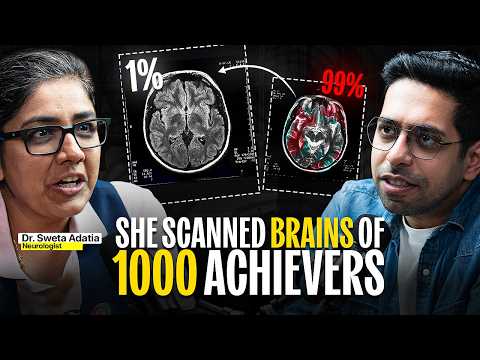
Dr. Sweta Adatia, a leading neurologist, explains how understanding brain functions, managing distractions, practicing gratitude, and adopting specific routines can enhance brain performance and help individuals join the top 1% achievers. She discusses the importance of self-awareness, proper sleep, breathing techniques, and the role of neuroplasticity in rewiring the brain for success.
Dr. Sweta Adatia, a renowned neurologist and founder of Limitless Brain Labs, shares profound insights into how the human brain works and how we can harness its full potential. With over 50,000 patients treated and extensive research on the brains of billionaires and extraordinary achievers, Dr. Adatia reveals the secrets behind why only 1% of the world's population can manifest their imagination into reality while the rest remain stuck in repetitive thought loops.
Humans have a prefrontal cortex that constitutes about 40% of the brain, compared to only 7% in rats. This part of the brain is responsible for executive functions such as prioritization, attention, judgment, emotional regulation, and creativity. Despite this, many people live lives akin to rats in a race, unable to fully utilize this potential.
One of the biggest challenges today is distractibility. Our limbic system acts as a watchdog, constantly scanning for threats, which leads to emotional overstimulation and a loop of negative thoughts. This results in procrastination, lack of clarity, and inability to focus.
Successful individuals often practice what is called "distanced self-talk," where they talk to themselves in the second person, providing motivation and clarity. This technique helps in managing emotions and maintaining focus.
Gratitude is a powerful practice that can increase the thickness of the prefrontal cortex by 5-10% and reduce amygdala activity by 20-30%. Regular gratitude practice rewires the brain, strengthens connections, and improves speech areas. It is essential to practice gratitude sincerely and consistently.
Studies show that humans think 50,000 to 60,000 thoughts daily, many of which are repetitive and revolve around health, relationships, and work/money. These repetitive thoughts can limit progress. Training the brain to reduce unnecessary thoughts and focus on execution is key.
Peak performers exhibit functional coupling, where the brain networks responsible for visualization and action work simultaneously. This allows them to visualize goals and take action effectively, unlike most people who either only visualize or only act.
Breathing is the master key to the brain. Conscious deep breathing techniques, such as yogic breathing at 5.5 breaths per minute, activate the prefrontal cortex and calm the amygdala, putting the brain in a state of coherence. Different brain waves (beta, alpha, theta, delta, gamma) correspond to different states of consciousness and brain activity.
Dr. Adatia studied the routines of top leaders, athletes, and meditators to create a framework called "MOVERS":
Incorporating these components into daily life can enhance brain function and productivity.
Quality sleep is crucial for brain repair, memory consolidation, and toxin removal via the glymphatic system. Adults need about 8 hours of sleep, with the first four hours being deep (non-REM) sleep and the last four hours involving REM sleep. Poor sleep disrupts brain function and can lead to cognitive and emotional issues.
The current generation faces unique challenges due to instant gratification from technology and social media, leading to dopamine overstimulation and addiction to cheap dopamine sources like reels and notifications. This reduces motivation and concentration.
Men tend to have a more monofocal brain activity, while women have faster relay of information between both hemispheres, enabling better multitasking. Emotional processing is also different, with women being more emotionally expressive.
Psychedelics like microdosing psilocybin are being studied for therapeutic use in controlled environments to help rewire brain circuits, especially for conditions like PTSD and severe depression. However, misuse can cause permanent damage to brain circuits.
Dr. Sweta Adatia emphasizes that the brain is a powerful organ with limitless potential that can be optimized through understanding, training, and conscious practices. By managing distractions, practicing gratitude, maintaining good sleep, and adopting effective routines, anyone can enhance their brain's capabilities and join the ranks of the top achievers. The journey requires effort, self-awareness, and consistency but promises transformative results.
Unlock your limitless brain potential today by embracing these neuroscience-backed strategies and living a purpose-driven life.