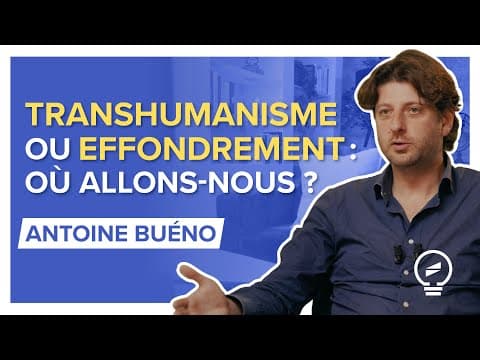
Antoine Buéno discusses the complexities of predicting the future, the potential for societal collapse due to environmental issues, and the transformative impact of technology and genetics on humanity over the next century.
In a recent discussion, Antoine Buéno, a specialist in foresight and prospective studies, delves into the intricate dynamics of predicting the future and the potential challenges humanity may face in the coming century. This blog post summarizes his insights on environmental issues, technological advancements, and the implications of genetic manipulation.
Buéno emphasizes that predicting the future is fraught with challenges due to the chaotic and complex nature of global interactions. He argues that even if humanity were to stop carbon emissions overnight, natural processes would continue to emit greenhouse gases like carbon and methane. This raises concerns about losing control over the planet's climate system, which could lead to catastrophic consequences.
One of the critical factors influencing resource consumption is population growth. Buéno points out that there are currently 80 million unintended pregnancies each year, which coincides with an increase of 80 million people on the planet annually. This demographic trend exacerbates the strain on Earth's resources, a reality often overlooked in environmental debates.
Buéno highlights the rapid advancements in genetics, suggesting that individuals can now engage in genetic manipulation from their homes. He notes that by the end of the 21st century, artificial intelligence (AI) is expected to surpass human cognitive abilities, fundamentally altering the landscape of human capabilities.
As a prospective thinker, Buéno advocates for long-term thinking in addressing future challenges. He reflects on historical attempts to predict the future, such as early 20th-century illustrations of life in the year 2000, which often missed significant technological shifts like the advent of computers. He argues that while some predictions may fail, others, like those made by thinkers such as Tocqueville and Orwell, have proven remarkably accurate.
Buéno identifies climate change as the most pressing threat to humanity. He warns that if global temperatures rise beyond critical thresholds, we may trigger irreversible feedback loops that could lead to widespread ecological collapse. He stresses that the consequences of failing to address climate change could be dire, potentially resulting in the collapse of our current civilization.
The idea of societal collapse is gaining traction, with many believing that our industrial system, reliant on finite resources, is unsustainable. Buéno references the Club of Rome's 1972 report, which predicted that unchecked growth would lead to collapse by the early 21st century. He defines collapse as the cessation of mass production and the inability to sustain the global population, leading to a return to pre-industrial living conditions.
Buéno critiques the focus on individual actions in combating climate change, arguing that systemic changes are necessary. He believes that while individuals can contribute, the scale of the problem requires collective action and structural reforms in our economic and industrial systems.
Buéno expresses a complex relationship with transhumanism, acknowledging the potential benefits of genetic advancements while cautioning against the risks. He believes that genetic engineering could lead to significant improvements in human health and longevity, but warns that these technologies must be approached with caution to avoid unintended consequences.
Looking ahead, Buéno is optimistic about the potential for space exploration to provide solutions to Earth's resource challenges. He discusses the concept of space mining, where resources from asteroids could be harnessed to alleviate the pressures on Earth's environment.
Antoine Buéno's insights into the future highlight the intricate interplay between technology, population dynamics, and environmental sustainability. As we navigate the complexities of the 21st century, it is crucial to adopt a long-term perspective and consider the broader implications of our actions today. The future may hold both challenges and opportunities, and it is our responsibility to shape it wisely.