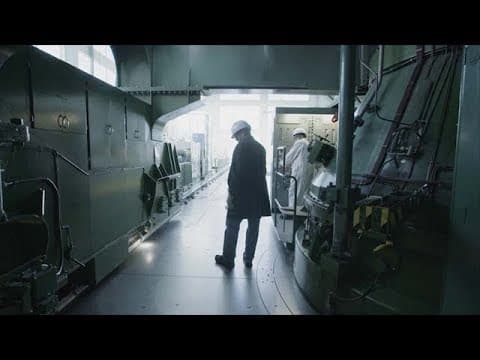
The National Research Universal (NRU) reactor in Chalk River, Ontario, has played a pivotal role in nuclear research and medical isotope production for over 60 years. This blog post explores its historical significance, technological innovations, and the impact it has had on science and healthcare, culminating in its recent shutdown.
For the first time, cameras have taken us inside Canada's top-secret $20 million research plant located in Chalk River, Ontario. This facility has been a cornerstone of atomic development in Canada, showcasing the strict access rules that have historically surrounded nuclear research. The reactor here produces a highly controlled slow-motion atomic explosion, generating no radioactive isotopes, and serves as a vital resource for atomic researchers.
The journey of nuclear research in Canada began with the groundbreaking discovery of nuclear fission in 1939, which shattered the long-held belief that atoms were indivisible. This revelation prompted governments worldwide to mobilize their best scientists to explore nuclear physics. During World War II, Canada became involved with the Manhattan Project, leading to the establishment of a significant laboratory dedicated to nuclear research.
The Canadian government sought a location for a large laboratory that was remote enough to avoid detection by enemy spies yet accessible for personnel and resources. After considering various sites, they settled on Chalk River, where the NRX reactor was built. The primary objective was to create a facility capable of splitting atoms and generating neutrons for scientific exploration.
The NRX reactor, which became operational in the late 1940s, was the largest research reactor in the world at that time. Its construction required the invention of numerous tools and instruments to measure and control nuclear reactions, as no existing catalogs provided the necessary equipment. This innovative spirit was a hallmark of the Canadian engineering community.
Ten years after its inception, the NRX reactor had proven so successful that plans were made to construct a second reactor, the NRU, which would be ten times more powerful. By 1957, both reactors were operational, marking a significant achievement in nuclear science and technology.
The production of radioactive isotopes at Chalk River has had a profound impact on medical science. Isotopes produced here have been used in various applications, including cancer treatment and medical diagnostics. The facility has been responsible for producing molybdenum-99, a crucial isotope used in medical imaging, which has saved countless lives.
The Canadian Neutron Beam Center (CNBC), a collaboration between Canadian Nuclear Laboratories and the National Research Council of Canada, has been instrumental in conducting neutron scattering experiments. This research allows scientists to investigate materials at the atomic level, contributing to advancements in technology and materials science.
The NRU reactor has not only been a leader in nuclear power generation and medical isotope production but has also played a crucial role in training the next generation of scientists and engineers. Over its 60 years of operation, it has produced a wealth of knowledge and expertise that continues to benefit Canada and the world.
In 2018, the NRU reactor was officially shut down, marking the end of an era. This decision was met with mixed emotions, as many employees reflected on the reactor's legacy and the lives it had touched. The shutdown was a bittersweet moment, symbolizing both the end of a significant chapter in nuclear research and the beginning of new opportunities for future advancements.
Despite the shutdown of the NRU, the legacy of nuclear research in Canada continues. The expertise developed over the decades remains invaluable, and there is a growing recognition of the role nuclear energy can play in addressing climate change and providing clean energy. Canada has the potential to lead in the peaceful use of nuclear technology, aligning with the ethos of "Atoms for Peace" initiated by President Eisenhower in the 1950s.
The story of the National Research Universal reactor is not just about a facility; it is about the people who dedicated their lives to advancing science and improving healthcare. As Canada looks to the future, the lessons learned from the NRU will guide the next generation of nuclear research and innovation, ensuring that the contributions of this remarkable facility are not forgotten but rather celebrated and built upon.