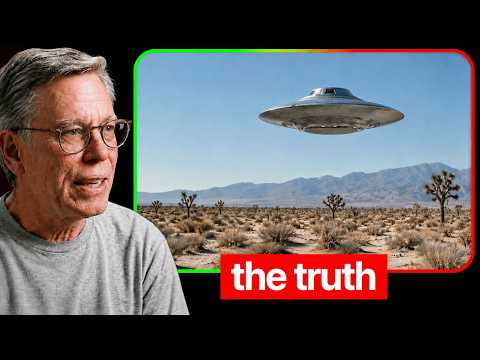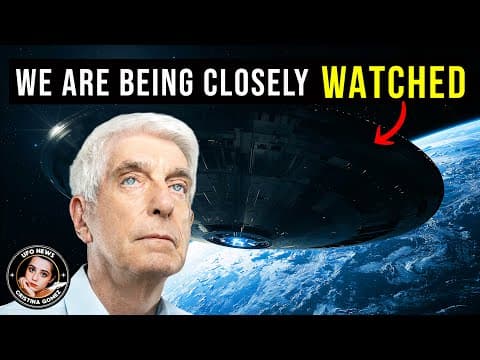
Jacques Vallee, a prominent computer scientist and UFO researcher, shares groundbreaking insights on UFO phenomena, suggesting they may be part of a control system influencing humanity. His extensive research reveals a classified database of UAP encounters and raises critical questions about our survival and the nature of these phenomena.
What if everything we think we know about UFOs is wrong? What if they are not visitors from space, but something far more complex and potentially dangerous? Computer scientist Jacques Vallee, who inspired the French scientist character in Close Encounters of the Third Kind, has spent 60 years studying this phenomenon, and what he's discovered may change how we perceive reality itself.
In a recent interview with the Soul Foundation, Vallee discussed several chilling revelations, including mysterious deaths linked to UFO encounters and a massive classified database containing 240,000 UAP (Unidentified Aerial Phenomena) cases. Vallee proposes a controversial theory that we are dealing with a control system that has been manipulating humanity for centuries. He emphasizes that our survival as a species may depend on figuring out how to communicate with this system, and time is running out.
Vallee began his research by building databases based on French cases and other European incidents. He noted that the idea of a control system emerged during discussions with colleagues at French universities. He stated, "What is it? We have many thousands of cases. So it's doing something. It's not hiding. It's in fact in full view."
In his latest book, Forbidden Science Volume 6: Scattered Castles, published in January, Vallee analyzes over 500 high-strangeness cases. His findings led him to view UAP as projections into our reality, akin to a simulated environment. Initially, Vallee supported the extraterrestrial (ET) theory, believing UFOs were visitors from another planet. However, after analyzing thousands of cases, he found patterns that did not fit this narrative. The behavior of these phenomena was too absurd, theatrical, and focused on psychological impact rather than scientific inquiry.
One particular case involved disc-shaped objects resembling modern drones, which exchanged light beams in the sky. This incident, occurring in the late 1970s, raised suspicions of a new weapon being tested. When investigators arrived, they found a truck with what appeared to be a dead body, which may have been a decoy. A uniformed man instructed them to leave, claiming there was nothing to see.
From 2008 to 2010, while working under top-secret clearance for the intelligence community's Advanced Aerospace Weapons System Applications Program (AAWSAP), Vallee and his team created an unprecedented data warehouse containing 240,000 cases from around the world. This database integrated 13 to 14 separate databases, including translated foreign reports from 393 sources. The goal was to refine the data, focusing on the top 20,000 cases that could be shared with the scientific community across various disciplines.
However, after just two years and $22 million in funding, the program was terminated, and the database vanished into the classified world. Vallee confirmed the database's potential for AI-driven analysis but lamented its classification limits and lack of scientific access. He questioned the fate of the database, wondering if it was transferred to another program or left unused in a classified vault.
Vallee has strong opinions about the current congressional approach to UAP research. He criticized the notion that science should wait for congressional approval to study phenomena, stating, "When is the last time science had to wait for a decision of Congress to study something?" He argued that scientists should document and investigate anomalies without political interference. This tension between political oversight and scientific investigation continues to hinder serious research into UAPs.
Perhaps Vallee's most sobering revelation concerns humanity's future. He suggests that the phenomenon has been present for as long as humans have existed, raising questions about the current concentration of sightings. Vallee posits that we are at a critical evolutionary juncture, where a species must learn to manage its technology responsibly or face self-destruction. He draws from recent scientific papers discussing the great filter hypothesis, which suggests that many civilizations may not survive the transition to advanced technology.
Vallee believes that the increased intensity of UAP activity may be related to this critical moment. If advanced intelligences are monitoring developing civilizations, they would recognize that we are approaching a make-or-break point.
Vallee's approach goes beyond passive observation. He built an observatory in Northern California, attempting to provoke a response from the phenomenon. On the last day of his research, a bright light illuminated the forest, waking a witness who described it as something alive saying goodbye. This experience suggested a sense of humor in the manifestations of UFOs, which Vallee found difficult to accept.
The timing of this event was too perfect to be a coincidence, occurring after years of silence. This aligns with patterns noted by other researchers, indicating that the phenomenon seems to avoid scientific documentation while maintaining just enough presence to continue the mystery.
After six decades of studying UFOs, Vallee reached a revolutionary conclusion: we are not dealing with visitors from space, but with something far more complex—a control system that has been shaping humanity's consciousness throughout history. Whether this system is guiding our evolution, testing our responses, or simply maintaining its hidden existence remains unclear. However, Vallee's research suggests that our survival may depend on learning to communicate with it intelligently.
The massive database his team built could have provided crucial answers, but instead, it disappeared into the classified world, leaving us with congressional hearings that address symptoms rather than causes.
Do you think Vallee's control system hypothesis explains UFO behavior better than the ET hypothesis? Share your thoughts in the comments below.