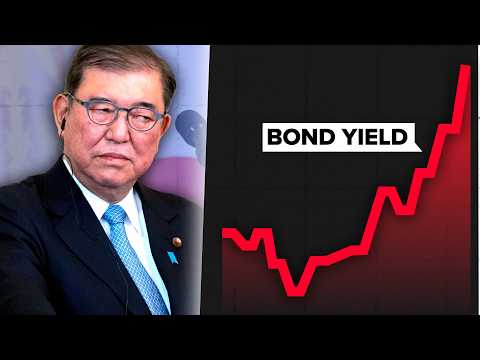
Japan faces a severe economic crisis as its debt-to-GDP ratio exceeds 240%, prompting concerns about its ability to manage rising inflation and interest rates. Prime Minister Ishiba's warning about Japan's fiscal situation being worse than Greece's highlights the urgency of the situation, as bond yields spike and the government struggles to normalize its economy.
Japan's economic landscape has been a topic of concern for many years, particularly as the country grapples with an enormous debt burden. Recently, Prime Minister Shagaru Ishiba made headlines by stating that Japan's fiscal situation is worse than that of Greece. This alarming comparison comes at a time when Japan's long-term borrowing costs have surged, raising questions about the sustainability of its economic policies.
After World War II, Japan experienced remarkable economic growth, averaging 7% annually from 1955 to 1990. However, the 1990s brought a series of economic shocks that led to a prolonged period of stagnation. Following a massive boom in the 1980s, residential house prices plummeted by over 50%, commercial property prices fell by approximately 85%, and the Nikkei 225 stock index dropped by about 75%. This period of stagnation saw both growth and inflation fall close to zero.
In response, the Bank of Japan (BOJ) implemented aggressive monetary policies, including purchasing government bonds to inject liquidity into the economy. Despite these efforts, Japan struggled to escape its deflationary cycle, and by 2022, the country's debt-to-GDP ratio had ballooned to over 240%, one of the highest in the world.
In early 2022, a global inflationary shock pushed Japan's annual inflation rate above 2% for the first time in nearly a decade. Policymakers viewed this as an opportunity to stimulate the economy by encouraging a wage-price spiral, where rising prices would lead to higher wages, thus boosting consumer spending. While wage growth did improve in 2024, reaching over 5% for large companies, inflation remained stubbornly high, complicating efforts to normalize the economy.
As inflation persisted above the BOJ's target, the central bank was forced to raise its benchmark interest rate to 0.5%, the highest level since 2008. This seemingly modest increase has significant implications for Japan's economy, as the country's massive debt means that even slight rate hikes lead to substantial increases in debt servicing costs. Japan is projected to spend around 32 trillion yen on debt servicing next year, accounting for about 5% of its GDP.
The situation has escalated recently, with a sharp spike in Japanese bond yields, reaching levels not seen in decades. The yields on 30 and 40-year Japanese bonds have surpassed 3%, reflecting growing concerns about Japan's ability to manage its debt. This rise in yields is partly attributed to a broader increase in global bond yields, particularly following a downgrade of the U.S. credit rating by Moody's, which cited unsustainable debt levels.
Additionally, a recent weak bond auction raised alarms, as the Japanese government struggled to find buyers for long-term bonds. This has led to a lack of confidence in Japan's fiscal management, particularly under Prime Minister Ishiba, whose popularity has waned.
The BOJ now faces a critical dilemma: should it trust Ishiba to implement the necessary fiscal discipline to address the debt crisis, or should it resume purchasing government debt to alleviate immediate pressure? Restarting bond purchases could ease the burden on the government but would also signal a failure to return to a normalized economy. This could complicate trade negotiations with the U.S., as a return to loose monetary policy might weaken the yen, a point of contention in past discussions.
Japan's path to economic normalization is fraught with challenges. The combination of high debt levels, rising interest rates, and persistent inflation creates a precarious situation for policymakers. As the government grapples with these issues, the urgency for effective fiscal management has never been greater. The coming months will be crucial in determining whether Japan can stabilize its economy or if it will continue to face a looming debt crisis that could have far-reaching implications for its future.