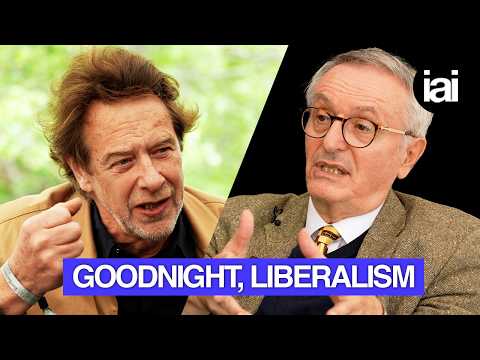
Philosopher John Gray critiques Enlightenment liberalism, arguing it imposes dogmatic rationalism and fails to account for the complexities of human nature and cultural diversity. He advocates for embracing fragmented societies, skeptical inquiry, and historical context, while rejecting utopian social planning and simplistic optimism.
Philosopher John Gray offers a profound critique of Enlightenment liberalism, challenging its foundational assumptions about reason, progress, and human nature. In a wide-ranging discussion, Gray explores the tensions between objectivity and skepticism, the limitations of rational social planning, and the necessity of embracing cultural fragmentation and historical context.
Gray begins by reflecting on the rich tradition of stylized debates in medieval Tibet, which questioned the very foundations of Buddhism and Tibetan society. These debates were central rituals in monastic life, embodying a beautiful intellectual openness. He contrasts this with the dogmatism he perceives in contemporary Western universities, where rigid ideologies are often imposed on young minds, stifling genuine inquiry.
While Gray acknowledges the importance of historical facts and certain enduring features of human nature discernible through history and experience, he resists the outright relativization of human nature. He draws on the influence of philosophers like Schopenhauer, who embraced radical skepticism but still believed there was much to be sound about.
Gray opposes recent thinkers who deconstruct human nature entirely, arguing that such views lead to presentism and a narrow fixation on current perspectives. He emphasizes that philosophy must be done historically, understanding ideas within their historical contexts.
Gray rejects the Socratic method as it is commonly portrayed—philosophy as dialectic persuasion. Instead, he aims to stimulate thought by shaking up established worldviews and highlighting their cultural and temporal limitations. His writing style, described as aphoristic and paradoxical, is intended to provoke reflection rather than convince readers of a particular ideology.
Gray identifies as a radical nominalist, viewing words, concepts, and frameworks as inventions that evolve and sustain themselves like spider webs. He resists the idea that human concepts constitute reality, seeing such views as anthropocentric and a form of human solipsism. Language, for Gray, is metaphorical and provisional, reflecting the openness of the world rather than a fixed reality.
Gray notes that mainstream philosophy, especially in the English-speaking world, often maintains a traditional realist approach to language and reality, which he finds increasingly unsustainable in a world shaped by technology and scientific developments. He points out that actual scientists, such as Heisenberg, have been influenced by non-realist traditions, contrasting with the philosophical mainstream.
Gray critiques the Enlightenment's rational plan for society, linking it historically and logically to dictatorship due to its failure to accommodate the diversity within society and individuals. He explains his political instincts align more with thinkers like Burke and Hobbes, who emphasize stability and order without attempting to unify society under a single rational plan.
He reflects on his own political journey from an old Labour voter to a critic of rational social planning, emphasizing the inherent tyranny in trying to impose a single societal blueprint.
Gray acknowledges a personal tension between his desire to challenge mainstream Enlightenment ideas and his support for social stability and order. He admires societies that allow skeptical, playful intellectual life while maintaining traditions—not blind traditions, but those that provide a framework for civic peace.
He contrasts this with the current state of Western societies, which he sees as fragmented and unable to restore lost cultural unity. Gray draws on historical examples, such as the Aztecs, to illustrate radical cultural variations and the dangers of viewing one's own culture as the pinnacle of humanity.
Gray discusses populism as a liberal term describing political backlash against social disruption caused by liberal policies. He criticizes liberal leaders who fail to understand this dynamic, dismissing populism as mere demagoguery without recognizing their own role in creating the conditions for backlash.
He argues that the current wave of populist movements reflects shared pathologies resulting from hyper-liberalism's sclerotic dogmatism.
Gray rejects the idea that cultural stability and order require monolithic unity. He argues that such unity is neither possible nor desirable in contemporary societies, which must learn to live among fragments. Attempts to enforce cultural homogeneity would lead to hatred, suffering, and despair.
He appreciates the cracks and fractures in culture, seeing them as salvific and preventing the rise of immutable utopias or AI gods. Rust and decay, metaphorically, are the saviors that prevent totalitarian perfection.
Gray interprets the festival title "How the Light Gets In" as a metaphor for the necessity of confronting darkness to appreciate light. Turning away from darkness is a mistake because the darkness is always present and interested in us. He warns against focusing solely on darkness, which can consume the observer.
He contrasts his view with Schopenhauer's metaphysical pessimism, favoring a more nuanced approach that acknowledges both light and dark aspects of existence.
Gray is often labeled metaphysically pessimistic, but he attributes this perception to living in a culture saturated by optimism. He critiques the Enlightenment as a neo-Christian project that secularized biblical ideas but lost their moral and psychological realism.
He admires Christian moral realism, especially Augustine's, and the profound cultural inheritance of the Old Testament. However, he suggests that continuing with Enlightenment ideals without embracing their Christian roots leads to nonsense.
John Gray's critique of Enlightenment liberalism challenges us to reconsider our assumptions about reason, progress, and human nature. He advocates for a philosophy grounded in historical context, skeptical inquiry, and acceptance of cultural fragmentation. His insights call for humility in our worldview and caution against utopian social engineering, emphasizing the complexity and diversity of the human condition.
This conversation invites readers to engage deeply with the philosophical underpinnings of modern society and to reflect on the balance between change and stability in an increasingly fragmented world.