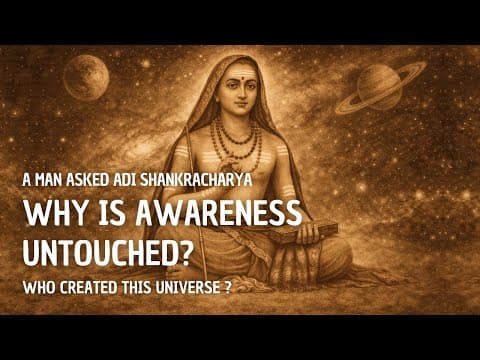
A profound dialogue with Adi Shankaracharya reveals that the universe is not created but appears as an illusion within consciousness. Awareness, the true self, remains untouched by creation, pleasure, or pain. The concept of a creator arises from ignorance and separation, but ultimate reality, Brahman, is unborn and beyond creation. Understanding oneself as the witness leads to freedom from suffering and clarity beyond illusion.
A man, well-versed in scriptures and experienced in debates and worship, once approached the great philosopher Adi Shankaracharya with a burning question: "Who created this universe?" This question, simple yet profound, led to a deep exploration of existence, creation, and awareness.
Shankaracharya did not answer immediately. Instead, he invited the man to consider the question differently. He asked, "Who is asking?" Before the question arose, before the universe appeared in the mind, the self already existed. He challenged the man to think about the universe's existence during his childhood or deep sleep, when the mind was dissolved. If the universe was created, who was the creator during those times?
The key insight Shankara shared is that the question "Who created the universe?" belongs to the mind, which itself is part of the universe. He used the metaphor of a wave in the ocean: a wave cannot inquire about the ocean's origin while forgetting it is water itself. Creation is not an event or action but an appearance, much like a rope appearing as a snake in twilight — an illusion.
The universe is a misunderstanding, a projection like a dream. Just as no one creates the snake in the rope, no one creates the universe. The insistence on a creator arises from the false assumption that the universe is separate from the self. In reality, the universe is within you; when thought arises, the world appears, and when thought dissolves, the world disappears.
In deep sleep or Samadhi (a state of meditative absorption), the universe and creator are absent, highlighting their illusory nature. The concept of Ishvara (God or creator) exists within the universe, not outside it. Ishvara is Brahman (ultimate reality) reflected through Maya (illusion), like the sun's reflection trembling in water. This reflected image is not the ultimate reality but a distorted perception born of ignorance.
Shankara compared the universe to a dream where mountains, rivers, and people appear real but vanish upon waking. Similarly, the waking world is a longer dream sustained by collective belief. Time, space, causation, birth, and death all appear within Brahman but do not affect Brahman itself, which is unborn and eternal.
Scriptures speak of creation to communicate compassionately with seekers at different levels of understanding. To children, simple stories are told; to seekers lost in action, the language of creator and creation is used. But the highest teaching reveals that nothing was ever created or destroyed — there is only the eternal reality.
The man’s question about creation stems from a fear of groundlessness — a desire for a source or father of existence. However, truth has no parent. Brahman, the universe, and the self are unborn. Birth and death are stories consciousness tells itself.
Shankara advised not to fight or escape the illusion but to observe it. Awareness, the seer, remains untouched by pleasure, pain, or any experience. Like a dreamer unburned by dream fire, the witness remains stainless despite the arising of sensations, thoughts, and emotions.
Pleasure and pain are experiences, but the knower of these experiences remains unchanged. The witness neither clings to pleasure nor resists pain. It simply is.
Suffering arises not from pain itself but from identification with pain and resistance to it. Similarly, attachment to pleasure leads to suffering. The witness, called sakshi, is a mirror reflecting all experiences without judgment or participation.
The ego, which claims to be the doer or sufferer, is itself an appearance that changes and falls away. The true self is the unmoving center, like the hub of a spinning wheel.
One is not meant to escape pain but to outgrow confusion. When ignorance ends, pain may still arise but no longer defines the self. Clarity burns away ignorance without affecting the world.
Knowing oneself as the witness allows life to continue with work, love, and loss, but without bondage. Pleasure becomes a guest, pain a teacher, and awareness remains silent, whole, stainless, and free.
This profound teaching from Adi Shankaracharya invites us to look beyond the surface of existence, to question our assumptions about creation and self, and to realize the untouched awareness that witnesses all. It is a call to awaken from the dream of separation and to live in the clarity of our true nature.