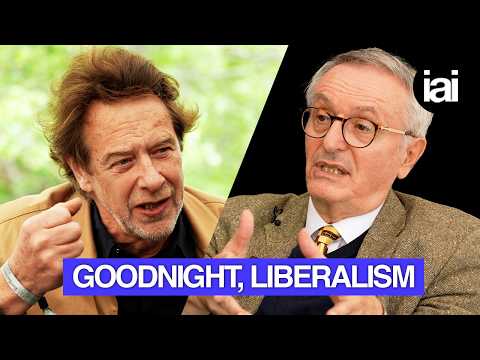
In a live conversation in London, philosopher Slavoj Žižek and podcaster Alex O'Connor (Cosmic Skeptic) explore Žižek's concept of Christian atheism, the role of theology in atheism, the nature of evil, and the complexities of contemporary politics. Žižek emphasizes the death of God as a metaphor for the absence of a higher cosmic order, advocates for active political engagement without hope, and critiques simplistic views on religion and society.
In a compelling live event in London, philosopher Slavoj Žižek engaged in a deep conversation with Alex O'Connor, known as Cosmic Skeptic, exploring themes of theology, atheism, politics, and the human condition. The discussion offered profound insights into Žižek's unique perspective as a Christian atheist and his critique of contemporary society.
The event began with a warm welcome and housekeeping notes, including the availability of Žižek's book Quantum Theory for sale and signing after the show. Žižek was introduced as a philosophical rock star, author, joker, and film star, known for his works such as On Progress, Too Late to Awaken, and Quantum Theory. Alex O'Connor, a podcaster and video maker, joined him for the conversation.
Žižek identifies himself as a Christian atheist, a term he defines precisely. He rejects the notion of a personal God but embraces Christianity as a framework that renounces the idea of a global, harmonious cosmic order that justifies evil or suffering. He contrasts this with cultural Christians who accept Christianity as a moral order despite disbelief in God.
He draws on Einstein's view of God as a Spinozist concept — not a personal deity but a representation of the universe's harmony, which he finds insufficient to explain quantum physics' indeterminacy. Žižek emphasizes that truth does not reside in a global perspective; rather, every totality or unity is partial.
The story of the crucifixion, according to Žižek and inspired by Hegel, symbolizes the death of the idea of God beyond itself — the death of the 'big other' or higher cosmic order. This death prohibits justifying horrors by appealing to a higher harmony, as seen in Stalinism or colonialism, where atrocities are sometimes rationalized as contributing to a greater good.
Žižek discusses the Book of Job as the first critique of ideology, where Job's suffering is shown to have no deeper meaning, challenging the common ideological explanations that suffering is deserved or a test. He highlights the importance of recognizing the absence of a higher cosmic justification for suffering.
He also critiques the idea of hope in politics, arguing that true political action begins in despair and the abandonment of hope. He references a debate from the movie Munich, where hope is described as a virtue for the lazy who expect others to act.
Žižek analyzes the political landscape, particularly in the United States and the UK. He identifies the traditional Republican and Democratic establishments as 'living dead' parties, with the real political options being Trumpian populism and democratic socialism. He praises figures like Mandami for targeting disenfranchised voters and breaking political norms.
He also critiques the idea of forced integration in multicultural societies, arguing that people often do not understand others or even themselves fully, and that polite distance and occasional friendliness are preferable to forced assimilation.
Žižek reflects on the COVID-19 pandemic's political lessons, noting that radical government interventions were possible and effective, challenging the notion that such measures would cause systemic collapse.
Addressing questions about death from an atheist materialist perspective, Žižek explains his view on death and consciousness. He distinguishes between negating a predicate (e.g., not alive means dead) and asserting a nonpredicate (e.g., undead), associating the latter with a horrifying state akin to zombies.
He is not afraid of death itself but fears the 'undeadness' of everyday life — a spectral existence marked by alienation. He warns about the dangers of artificial intelligence and digital immersion creating a perverse form of undeadness.
Žižek critiques the common skeptical attitude that we can never know the truth, arguing instead that truth inevitably returns, often in disguised forms such as symptoms or dreams. He encourages active engagement with reality rather than cynical detachment.
Žižek concludes by emphasizing the need for philosophy in an era of confusion, where critical thinking is essential for addressing complex issues like abortion and political change. He references Marx's famous statement about philosophers interpreting the world and the need to change it, suggesting that in the 20th century, too much emphasis was placed on changing the world, and now it is time to interpret it.
The conversation between Slavoj Žižek and Alex O'Connor traversed complex philosophical and political terrain, challenging conventional views on religion, atheism, suffering, and political action. Žižek's concept of Christian atheism rejects comforting cosmic justifications for evil and calls for a sober, active engagement with the world's harsh realities. His political analysis highlights the fragmentation and transformation of contemporary politics, while his reflections on death and skepticism offer a nuanced materialist perspective on human existence.
This dialogue underscores the enduring relevance of philosophy in understanding and navigating the challenges of modern life.