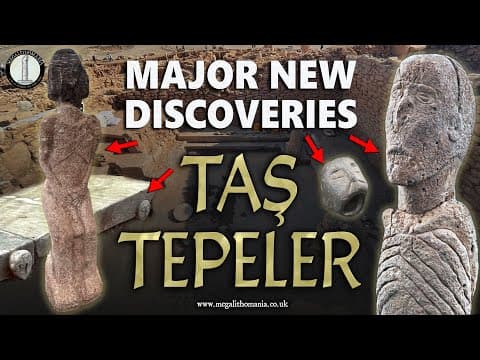
Recent excavations in southeast Turkey's Taş Tepeler region, including Göbekli Tepe, Karahan Tepe, Sefer Tepe, and Sayburç, have uncovered remarkable artifacts and structures dating back to 9,000 BC and earlier. These findings include statues, carved heads, a large temple room, and symbolic motifs, shedding light on early human culture and connections across the Mediterranean.
Recent archaeological excavations in southeast Turkey have brought to light a series of major discoveries in the Taş Tepeler region, a cultural area encompassing multiple prehistoric sites including Göbekli Tepe, Karahan Tepe, Sefer Tepe, and Sayburç. These findings are reshaping our understanding of early human civilization and its symbolic and ritualistic practices.
The Taş Tepeler region, located in southeast Turkey, is home to at least 12 known archaeological sites, with Göbekli Tepe and Karahan Tepe being the most prominent. This area has become a focal point for understanding the prehistoric period, particularly the Neolithic era, with discoveries dating back as far as 9,400 BC.
At Göbekli Tepe, a statue embedded in a wall near enclosure D was uncovered, believed to be a votive offering or possibly a reused stone piece. Karahan Tepe has revealed a giant rectangular temple room beneath the ground, measuring approximately 30-40 feet wide and 20-30 feet in length. This structure features benches along the sides, large walls, and T-pillars in each corner, representing a unique architectural achievement in the region.
Additionally, a statue initially thought to be female was re-examined and identified as male due to the presence of a phallus, though the hairstyle resembles that of goddess statues found in Malta. Another discovery at Karahan Tepe includes a statue with a beard similar to the famous 7.5-foot statue found there in late 2023.
Sefer Tepe, located near Karahan Tepe, has yielded intriguing artifacts such as two carved heads emerging from the soil, carved from the same slab of stone. A small statue with two faces—one with a closed mouth and the other with an open mouth—was also found, though its meaning remains unknown.
At Sayburç, a human head was discovered months ago, and recently the body was found, allowing the statue to be reassembled and displayed at Karahan Tepe. This statue features pronounced ribs or possibly abstract wings and a sewn-up mouth, with eyes represented by mollusk shells, similar to burial practices observed in the Levant region.
The discoveries reveal recurring motifs such as open and closed mouths, mollusk shell eyes, and T-shaped faces with protruding eyes. These symbols suggest complex ritualistic or symbolic meanings, possibly related to death, burial, or spiritual beliefs.
The hairstyles on some statues resemble those found on goddess figures in Malta, indicating potential cultural connections or shared artistic traditions across the Mediterranean. The dating of these sites and artifacts suggests a lineage of cultural development from southeast Turkey through Europe and into Malta, possibly facilitated by land bridges or early seafaring.
Only about 5% of the Taş Tepeler region has been excavated so far, indicating that many more discoveries await. Recent efforts include removing olive trees at Göbekli Tepe to facilitate further excavation and conservation work, as well as the development of tourism infrastructure.
Japanese teams and other international experts are joining the excavation efforts at various sites, promising a surge in new findings and insights into prehistoric human culture.
The recent discoveries at Göbekli Tepe, Karahan Tepe, Sefer Tepe, and Sayburç represent a significant leap forward in our understanding of early human societies. The artifacts and structures unearthed reveal complex symbolic systems, architectural sophistication, and possible cultural connections spanning the Mediterranean.
As excavations continue and more of the Taş Tepeler region is uncovered, we can expect to gain deeper insights into the origins of human civilization and the development of ritualistic and artistic expression in the Neolithic era.
Stay tuned for further updates as this fascinating story unfolds.