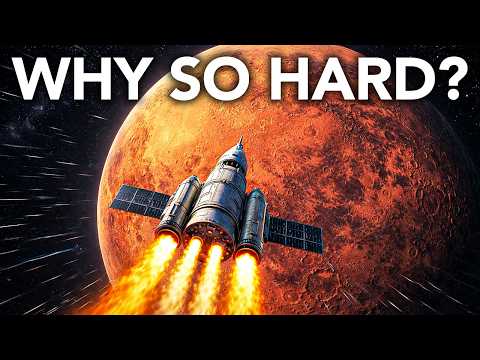
Despite humans landing on the moon over 50 years ago, Mars remains unreachable by humans due to its vast distance, longer travel time, harsh environment, and the complex challenges of survival, landing, and return. Mars demands extensive preparation, self-sufficiency, and endurance, making it a fundamentally different and more difficult journey than the moon missions.
Humans have walked on the moon more than half a century ago, planting flags, collecting rocks, and returning safely. Yet, Mars, a planet that has fascinated generations, remains untouched by human footsteps. This raises the question: Why is Mars so much harder to reach than the moon?
The answer is not simply about technology or money but involves deeper factors such as distance, time, risk, and the nature of the journey Mars demands.
The moon is about 384,000 km away from Earth, a distance that light and radio signals travel in just over a second. This proximity allowed near real-time communication between astronauts and mission control during the Apollo missions.
Traveling to the moon took about 3 days, allowing astronauts to return quickly if something went wrong. The moon's lack of atmosphere simplified landing, requiring only engine burns to slow down and touch down safely.
The moon's environment is predictable and stable, with no weather or atmospheric interference. Its gravity is about one-sixth of Earth's, making landing and movement easier.
Mars is not just farther away; it demands a different kind of commitment. Travel to Mars takes months, with launch windows opening only every 26 months due to the orbital mechanics of Earth and Mars.
Communication delays range from 4 to 24 minutes one way, making real-time conversation impossible. Once en route, astronauts cannot turn back quickly; they are committed to the entire mission duration, which includes months of travel, a long stay on Mars, and months to return.
Mars has a thin atmosphere that complicates landing. It is too thin for parachutes alone to slow descent but thick enough to cause heating and drag. This makes the entry, descent, and landing phase extremely challenging and risky.
Landing on Mars involves a complex sequence called the "7 minutes of terror," where the spacecraft must autonomously slow down from high speeds using heat shields, parachutes, and engines without any possibility of intervention from Earth.
Mars' gravity, about 38% of Earth's, and its thin atmosphere require precise timing and fuel management. The landing site must be carefully chosen to balance scientific interest and safety.
Dust storms and fine, electrostatically charged dust particles pose additional risks by obscuring sensors, damaging equipment, and affecting human health.
Mars' environment is cold, dry, and exposed to high levels of cosmic radiation due to the lack of a strong magnetic field and thin atmosphere. Radiation exposure accumulates over the long mission duration, increasing health risks.
The human body faces challenges from prolonged weightlessness during transit, partial gravity on Mars, and the psychological effects of isolation, confinement, and delayed communication.
Life support systems must operate autonomously and reliably for years, recycling air, water, and managing waste in a closed-loop system. Food production on Mars is necessary to sustain long missions, requiring controlled environments and careful management.
The long duration, isolation, and confinement of Mars missions impose significant psychological stress. Crews must maintain cooperation, manage conflicts, and sustain motivation despite monotony and delayed communication with Earth.
Sleep disruption due to altered light cycles and the absence of natural sensory inputs further complicate mental health.
Mars missions require sustained financial, political, and institutional commitment over decades. The mass and complexity of systems needed for long-term survival increase launch costs exponentially.
Unlike the Apollo program's intense but short effort, Mars exploration demands endurance, patience, and international cooperation.
Robotic missions have paved the way by exploring Mars, testing technologies, and revealing the planet's challenges. Robots tolerate the harsh environment better than humans and provide critical data for planning human missions.
Robotic explorers have demonstrated Mars' slow degradation effects on machinery and the need for autonomous operation due to communication delays.
Mars is much harder to reach than the moon not because of a single overwhelming obstacle but due to the accumulation of many persistent challenges: distance, time, environment, survival, and cost.
The moon allowed humanity to take a bold but brief step into space with a safety net nearby. Mars demands a long-term commitment, self-sufficiency, and respect for its harsh conditions.
Reaching Mars responsibly requires patience, preparation, humility, and endurance. It is not just a technological challenge but a test of human values and cooperation.
The red horizon waits patiently, reminding us that the difficulty of Mars is a natural consequence of bringing fragile human life into a world that offers no forgiveness for impatience.