This article explores the concept of the universe as a quantum information hologram, where mass is not separate from light but a manifestation of frequency and rhythm. It explains how the singularity and event horizon are entangled, with Hawking radiation bridging them, and how mass functions as a clock ticking at a rate proportional to its energy, uniting gravity, quantum physics, and energy into a coherent framework.
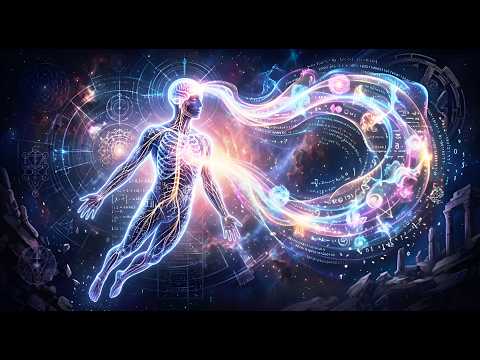
What if everything we perceive is not a fixed reality but a projection, written in light, interpreted by gravity, and rendered in real time? This intriguing idea is at the heart of quantum information holography, a concept that redefines our understanding of mass, time, and the universe itself.
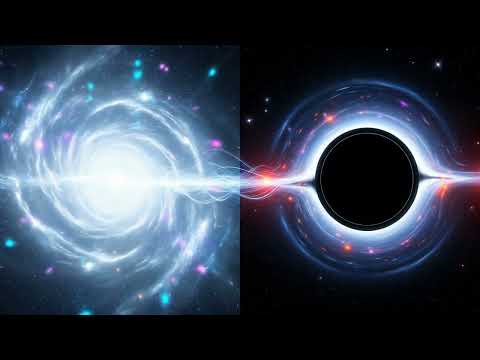
In the framework of quantum information holography, the singularity and the event horizon of a black hole are not separate entities but entangled partners in a single, unified process. At the core lies the singularity, described as pure spin — a superposition of all possible quantum states. Surrounding it is the event horizon, which acts as a holographic screen where information is displayed.
Hawking radiation serves as the crucial bridge between the singularity and the event horizon. It is the mechanism through which the singularity writes information outward, and the horizon reads it back in. This continuous exchange ensures that the information flow between the inside and outside of the black hole remains intact.
The singularity’s spin sets the fundamental phases — the basic rhythms of quantum states. The event horizon captures these rhythms as interference patterns. These patterns manifest as what we perceive as space, particles, and energy. As the singularity emits Hawking radiation, the horizon updates the cosmic picture, simultaneously writing, reading, and storing information.
This dynamic process means that reality is a live projection, updated tick by tick. The key insight here is that mass is not something separate from light; rather, it is the same information viewed through three different lenses.
The energy of any entity can be expressed in three equivalent ways:
E = H × F
E = ħ × ω
E = MC²
These three expressions reveal that mass itself has a frequency — a precise rhythm — which can be calculated as:
Thus, every piece of mass in the universe functions as a clock, ticking at its own intrinsic rate. The heavier the mass, the faster its internal rhythm spins.
When the event horizon projects these rhythms, we perceive them as rest mass, inertia, and the flow of time itself. Because the singularity and the horizon are entangled, the inside and outside of the black hole are unified in a single information flow.
The apparent separation between inside and outside is merely an illusion created by the projection. The same cycles that define mass also synchronize the universe: the phase at the center, the pattern at the boundary, and the objects we observe in the world.
Viewing mass as a clock provides a unifying narrative that connects gravity, quantum physics, and energy. The universe can be seen as a precision timepiece made of light, where the singularity and the horizon beat together in harmony. What we call matter is the rhythm stabilized on the holographic screen.
In this view:
The concept of mass as a clock challenges traditional notions of matter and time, offering a profound perspective on the nature of reality. By understanding the universe as a holographic projection of quantum information, where mass embodies rhythm and frequency, we gain insight into the deep connections between light, gravity, and the fabric of spacetime itself. This perspective not only enriches our understanding of physics but also invites us to see the cosmos as a living, dynamic projection — a cosmic clock ticking in perfect synchrony.