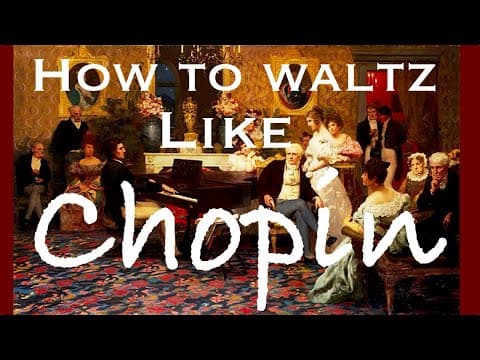
This blog post explores the waltz as a musical form, its historical significance, and the innovative techniques of Frederic Chopin that elevate this dance style into a sophisticated art form. It provides insights into the structure, harmony, and improvisational aspects of Chopin's waltzes, offering practical advice for musicians looking to incorporate his style into their own compositions.
The waltz is a captivating dance form that originated in the 18th century in Central Europe. It gained immense popularity as one of the first dance forms embraced by the newly emancipated bourgeoisie, gradually replacing the aristocratic minuet as the leading dance in triple meter. By the early 19th century, the waltz had reached its peak, becoming one of the most recognized forms of music in triple meter across modern societies.
Among the many composers who contributed to the waltz's evolution, Frederic Chopin stands out as a pivotal figure. When he settled in Paris in the early 1830s, Chopin left a lasting impact on contemporary and modern piano music. His unique style refined many musical forms, particularly the waltz, transforming it into a sophisticated art form that continues to captivate audiences today.
In this exploration, we will delve into various aspects of Chopin's waltzes, from their structure and harmony to specific techniques that can help musicians create their own compositions or improvisations in a Chopinesque style.
The waltz is fundamentally a dance, and understanding its structure is crucial for any musician looking to master it. Most of Chopin's waltzes can be classified as variations of a basic ternary form, often represented as A-B-A, where different themes or phrases are introduced and revisited. Some of his waltzes also exhibit characteristics of an anacrusic rondo, featuring recurring themes that may not necessarily be the piece's opening.
At its core, the waltz is built on the number two and its multiples, such as four, eight, or sixteen. This modularity is essential in creating phrases that resonate with listeners. For instance, a phrase can be constructed by combining two-bar segments, allowing for variations and repetitions that maintain the listener's interest.
Chopin's mastery of the waltz is evident in his innovative techniques. Here are some key techniques that can be implemented to create music inspired by Chopin:
Chopin often employed counterpoint in his waltzes, allowing the left hand to play a melody while the right hand provided harmonic support. This technique creates a rich texture that enhances the overall musical experience. For example, in his Grand Waltz in A-flat major, Chopin uses a unique texture that allows for a melody in double meter over a triple meter time signature.
Another effective technique is the use of groupings, which are collections of related notes that create micro-rhythms within the melody. These groupings can be structured around single notes or intervals, adding complexity and interest to the musical line.
Chopin's waltzes are characterized by their expressive melodies, often embellished with ornamentation. Techniques such as trills, turns, and grace notes can be used to enhance the emotional depth of a piece. Experimenting with these embellishments can lead to a more personal interpretation of the waltz.
Chopin's harmonic progressions are often straightforward yet effective. Many of his waltzes follow a simple eight-bar structure, with the harmony typically changing every bar. Understanding these progressions can help musicians create their own waltzes that capture the essence of Chopin's style.
Chopin was a master of modulation, often transitioning between keys with ease. One common technique involves using a single note as a pivot point to shift between different harmonies. This approach can create a sense of fluidity and surprise in the music.
The waltz, particularly in the hands of Frederic Chopin, transcends its origins as a simple dance form to become a profound expression of musical artistry. By understanding the structure, techniques, and harmonic language of Chopin's waltzes, musicians can explore their creativity and develop their own interpretations of this timeless genre. Whether through composition or improvisation, the waltz remains a vibrant and accessible form that invites exploration and innovation.