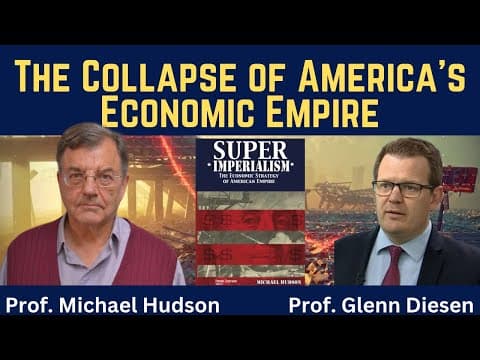
Michael Hudson discusses the economic foundations of the American Empire, tracing its origins from World War I to the present. He argues that the U.S. has relied on financial imperialism rather than military conquest, leading to a precarious economic situation. As the U.S. faces increasing debt and challenges to its dollar dominance, Hudson warns of the unsustainability of this model and the potential for a shift towards alternative economic systems.
In a recent discussion, economist Michael Hudson delves into the economic strategies underpinning the American Empire, particularly as outlined in his book "Super Imperialism: The Economic Strategy of American Empire." This exploration reveals how the U.S. has built its empire not through traditional military means, but through financial mechanisms that are now showing signs of instability.
Hudson begins by explaining that the U.S. has historically avoided overt military colonialism, opting instead for financial colonialism. The roots of this strategy can be traced back to the aftermath of World War I, when the U.S. imposed repayment demands on its allies, which set the stage for future economic dominance.
After World War I, European nations expected debt forgiveness, a common practice following major conflicts. However, the U.S. insisted on repayment for loans made before its entry into the war. This led to a cycle of debt that ultimately contributed to Germany's hyperinflation and economic collapse, paving the way for the rise of Nazism.
Hudson highlights the establishment of the International Monetary Fund (IMF) and the World Bank after World War II as tools for maintaining U.S. economic dominance. These institutions were designed to serve American interests, often at the expense of developing nations. The World Bank, for instance, has historically provided loans that perpetuate dependency rather than fostering self-sufficiency in recipient countries.
The IMF's policies have similarly enforced austerity measures that hinder economic growth in the Global South, forcing countries to prioritize debt repayment over domestic development. This has created a dual economy: one for the U.S. and its allies, and another for poorer nations that remain dependent on American financial systems.
Hudson notes that the U.S. began to experience balance of payments deficits in the 1950s, primarily due to military spending. This trend continued through the Vietnam War, leading to a situation where the U.S. had to pay gold to countries holding dollars, ultimately resulting in President Nixon's decision to abandon the gold standard in 1971.
This shift allowed the U.S. to finance its military expenditures without the constraints of gold reserves, effectively creating a system where other countries had to recycle their dollar holdings back into U.S. Treasury securities. This arrangement has enabled the U.S. to maintain its military and economic power, but it has also led to increasing debt levels that are now unsustainable.
Today, Hudson argues that the U.S. is facing a crisis of confidence in its financial system. The growing national debt, now nearing $37 trillion, raises questions about the U.S.'s ability to repay its obligations. Countries that once viewed U.S. Treasury securities as safe investments are beginning to seek alternatives, particularly as the U.S. imposes tariffs and sanctions that threaten their economic interests.
The geopolitical landscape has shifted, with nations like China and Russia exploring ways to establish alternative financial systems that do not rely on the U.S. dollar. Hudson emphasizes that the U.S. response to these developments has often been aggressive, treating any move away from dollar dependence as an act of war.
Hudson concludes by suggesting that the U.S. must reconsider its imperial ambitions if it hopes to maintain economic stability. He argues that empires are inherently costly and unsustainable, and that the U.S. must transition towards a more equitable economic model that prioritizes domestic production over financialization.
The current trajectory, characterized by increasing debt and reliance on coercive tactics, is not sustainable. Hudson warns that without significant changes, the U.S. risks losing its position as a global economic leader, as other nations seek to establish their own systems of trade and finance.
In summary, Michael Hudson's insights provide a critical examination of the economic foundations of the American Empire and the challenges it faces in an increasingly multipolar world. As the dynamics of global finance evolve, the U.S. must adapt or risk falling behind in the new economic order.