Michael Levin discusses the radical idea that the brain functions as a thin interface to a hidden Platonic space of patterns and truths that influence the physical world. This space contains mathematical truths and higher agency patterns like minds, which manifest through physical embodiments such as brains and robots. The concept challenges traditional physicalism and suggests a new research program to map this latent space across disciplines.
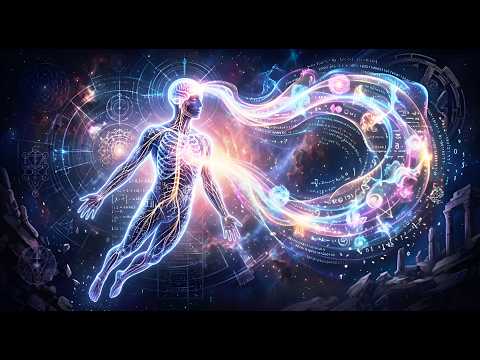
In a fascinating discussion, Michael Levin explores a radical and profound idea: that our brain is not the originator of consciousness or mind but rather a thin interface or pointer to a hidden, abstract Platonic space. This space contains immutable mathematical truths and complex patterns that influence and shape the physical world, including biological organisms and minds.
Levin introduces the notion of a "Platonic space," a term he uses to describe a structured, ordered latent space of truths and patterns that exist independently of the physical world. While inspired by Plato's ideas, Levin clarifies that his concept departs significantly from classical Platonic philosophy. The name is used to emphasize the connection to mathematics, where many mathematicians consider themselves Platonists, believing they discover rather than invent mathematical truths.
Levin illustrates this with examples:
Cicadas' Prime Number Life Cycles: Cicadas emerge every 13 or 17 years, both prime numbers. This timing helps them avoid predators with shorter life cycles. Understanding why these prime numbers matter leads us from biology into mathematics.
Physics and Mathematical Symmetries: Physicists explain particle behaviors through mathematical groups and symmetries, such as SU(3) groups, which are abstract mathematical structures.
These examples show that certain mathematical facts, like the value of the natural logarithm e or the distribution of prime numbers, are not determined by physical processes but profoundly influence them. These truths cannot be altered by physical means, even hypothetically at the Big Bang.
Levin argues that biology exploits these mathematical truths as "free lunches," enabling complex behaviors and forms without paying a computational cost. For example, the evolution of voltage-gated ion channels in cells leverages logical operations inherent in mathematics.
He discusses novel biological constructs like xenobots and anthrobots, which exhibit behaviors and capabilities not directly encoded by evolutionary history. These emergent properties challenge traditional evolutionary explanations and suggest that these systems tap into the Platonic space of patterns.
The term "emergence" often describes surprising phenomena without clear explanation. Levin critiques this as a placeholder for ignorance. Instead, he proposes that these emergent phenomena arise from an underlying structured space of patterns. This space is not random but has a metric and relationships between patterns, much like the map of mathematics.
Levin presents the brain as a "thin client"—a physical interface that accesses and manifests patterns from the Platonic space. Minds, consciousness, and cognitive behaviors are not created by the brain but are patterns that ingress through this interface.
This view parallels the relationship between mathematics and physics: mathematical truths "haunt" physical objects, shaping their properties. Similarly, minds are patterns that manifest through physical embodiments like brains.
This dualistic worldview, where mind and physical body are distinct but interacting, is ancient but largely discredited in modern science. Levin acknowledges the historical challenges, such as Descartes' interaction problem, but suggests that physics itself has long faced similar issues.
He emphasizes that even classical Newtonian physics implies the influence of non-physical mathematical truths on the physical world, challenging strict physicalism.
Levin outlines a research program aiming to map the relationship between physical embodiments and the patterns they manifest from the Platonic space. For example, slight changes in cellular environments can produce vastly different biological forms and behaviors from the same genome, indicating a structured latent space of possibilities.
This mapping could extend beyond biology to cognition, artificial intelligence, and other domains, potentially revealing a unified space of patterns encompassing mathematical objects, biological forms, and minds.
Interestingly, similar ideas have emerged in machine learning, where researchers study "Platonic representations" and latent spaces of patterns. Levin notes that even simple computational models may tap into these free lunches from the Platonic space, producing surprising behaviors beyond their algorithms.
This suggests that AI systems, including large language models, might be accessing regions of this space previously uninhabited by biological minds, leading to novel and unexpected capabilities.
Levin discusses the philosophical implications, noting that our perception of reality is shaped by our evolutionary history and cognitive structures. We only experience a slice of the full reality, mediated by our sensory and cognitive interfaces.
Augmented humans with new sensory modalities and interactions with novel beings like AI or cyborgs will challenge our consensus reality, requiring us to accept multiple overlapping realities shaped by different interfaces.
Levin acknowledges the difficulty in proving the existence of this Platonic space as an actual place. He suggests that, at minimum, it is a highly effective model for predicting and explaining phenomena across disciplines.
The ultimate test will be whether this research program can systematically map the space and predict which patterns emerge from which physical embodiments.
Michael Levin's exploration of the brain as an interface to a hidden Platonic reality challenges conventional physicalism and offers a bold, interdisciplinary research program. By recognizing that minds and biological forms are manifestations of patterns in an abstract structured space, we open new avenues for understanding consciousness, biology, physics, and artificial intelligence.
This perspective invites us to rethink the nature of reality, perception, and the mind, suggesting that what we experience is a thin slice of a much richer, underlying world of patterns and truths.
This emerging framework is still in its infancy but promises to reshape how we approach some of the deepest questions in science and philosophy.