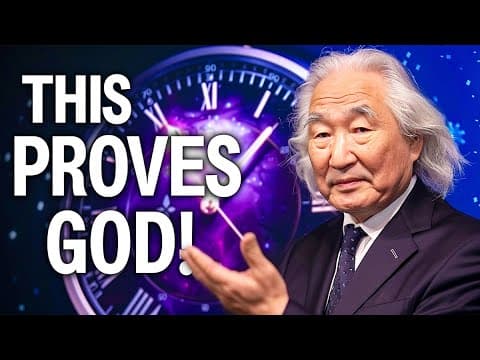
Renowned physicist Michio Kaku asserts that time does not exist, a claim supported by groundbreaking discoveries from the James Webb Space Telescope. These findings challenge the Big Bang Theory and our understanding of cosmic evolution, suggesting a need to rethink the nature of time and the universe itself.
The James Webb Space Telescope (JWST) has recently stirred the scientific community, prompting renowned physicist Michio Kaku to make a startling declaration: time does not exist. This assertion, which seems to contradict our everyday experiences, is rooted in the telescope's groundbreaking discoveries that challenge long-held beliefs about the universe's origins and evolution.
Launched on Christmas Day in 2021, the JWST follows in the footsteps of the iconic Hubble Space Telescope but boasts enhanced capabilities. Positioned in the vastness of space, it serves as a powerful tool for exploring the universe's deepest mysteries. Equipped with advanced infrared technology, the JWST acts like a time machine, allowing scientists to peer into the fabric of time itself.
Since its launch, the JWST has embarked on a cosmic voyage, unveiling ancient enigmas of distant galaxies and celestial bodies, revealing relics from the universe's infancy. These discoveries have forced astronomers to confront profound questions about cosmic evolution, particularly regarding the Big Bang hypothesis, which posits that the universe was created in a massive explosion 13.7 billion years ago.
For decades, the prevailing theory described a universe born from a massive explosion. However, the images captured by the JWST have challenged this narrative, depicting a cosmos that defies expectations. Astronomers like Allison Kirkpatrick from the University of Kansas are now grappling with the implications of these findings, which suggest that galaxies observed by the JWST do not conform to established theories.
To simplify the complex puzzle presented by the JWST, consider the universe as an expanding balloon. According to the expanding universe concept, as galaxies move away from us, their light should stretch, making them appear larger. However, JWST images reveal a surprising twist: distant galaxies appear to be about the same size as those nearby. This challenges the notion of an expanding universe and raises questions about the nature of redshift, which is often interpreted as a function of distance.
One particularly intriguing example is the galaxy named GH2, which the JWST observed. Despite being much brighter than our Milky Way, GH2 spans only 300 light-years, compared to the Milky Way's 50,000 light-year expanse. This means that GH2's brightness per unit area is an astonishing 600 times greater than that of the brightest nearby galaxy. Such dense and powerful galaxies challenge our understanding of cosmic expansion and the Big Bang Theory.
Another significant aspect to consider is the age of stars in these galaxies. According to the Big Bang Theory, everything came into existence following a massive explosion. However, if some galaxies house stars older than the Big Bang itself, it could revolutionize our understanding of the universe's origins. The JWST captures images that suggest galaxies as massive as the Milky Way existed just a few hundred million years after the supposed Big Bang, raising questions about how so many large galaxies could form in such a short time.
Recent research has revealed that the Big Bang Theory may be off the mark on several fronts, with 16 contradictions identified. While it accurately predicts the abundance of deuterium, it overestimates helium and lithium quantities. Additionally, the theory struggles to explain the existence of massive cosmic structures, suggesting that these structures should not have had enough time to form since the universe's inception.
The implications of these discoveries extend beyond cosmic structures; they challenge our fundamental understanding of time itself. Kaku's assertion that time does not exist invites us to reconsider our perception of reality. Some theories suggest that time is merely a human construct, shaped by our memories, and that all events—past, present, and future—exist simultaneously in a four-dimensional spacetime.
British physicist Julian Barber offers a unique perspective, viewing reality as a sequence of distinct moments, akin to snapshots in a photo album. He argues that our perception of the past is a construct of our memories, suggesting that the past may be an illusion. This idea resonates with Einstein's theory of spacetime, which intertwines space and time.
As scientists continue to analyze the data from the JWST, the potential for a paradigm shift in our understanding of the universe looms large. The discoveries challenge not only the Big Bang Theory but also the very fabric of spacetime itself. The search for a unified theory that reconciles general relativity and quantum physics remains a pressing challenge in modern physics.
Innovative physicists are proposing new ideas that could reshape our understanding of spacetime. Instead of viewing spacetime as a separate entity, some suggest that it emerges from quantum interactions. This perspective could unlock solutions to longstanding puzzles in theoretical physics and deepen our comprehension of the universe's fundamental nature.
The revelations from the James Webb Space Telescope have opened new avenues of exploration and discovery, prompting us to rethink our understanding of time, space, and the universe itself. As we grapple with these profound questions, one thing is clear: our perception of the cosmos is evolving, and the universe still holds many surprises. What do you think? Does time truly exist, or is it merely a construct of our minds?