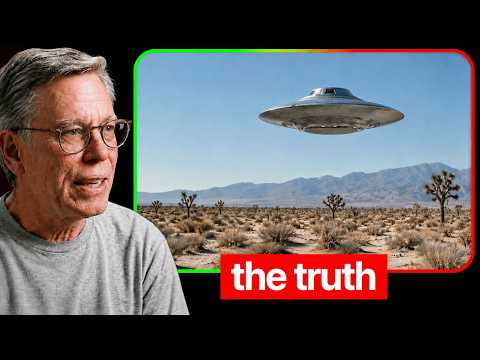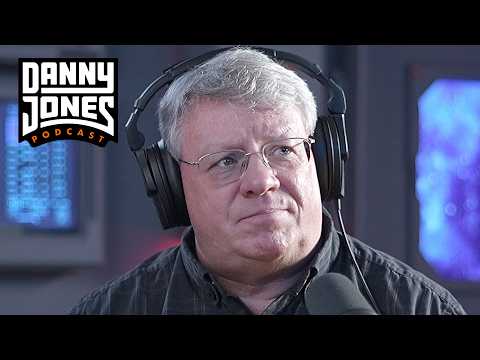
In a revealing conversation, NASA physicist Kevin Knuth shares insights on his journey from studying brain dynamics to working at NASA, his views on UFOs, and the challenges of returning to the Moon. He discusses the importance of scientific inquiry into UAPs, the potential for new energy sources, and the need for renewed interest in lunar exploration.
In a fascinating discussion, NASA physicist Kevin Knuth shares his journey from studying the dynamics of the human brain to working at NASA and his evolving views on UFOs and space exploration. This blog post delves into his experiences, insights, and the broader implications for humanity's future in space.
Kevin Knuth's academic journey began with a PhD in physics, where he focused on the dynamics of the human brain in response to auditory stimulation. His work involved studying the magnetic fields generated by neurons, leading him to develop algorithms for separating mixed signals using early machine learning techniques.
His transition to NASA came after a collaboration with an astronomer friend at a neuroscience conference, where he helped analyze data for a project aimed at detecting wobbling stars to find exoplanets. This collaboration sparked his interest in astrophysics and ultimately led to a job in NASA's Intelligent Systems Division, where he worked for four years.
At NASA, Knuth was involved in studying planetary nebulae and developing 3D models of these celestial phenomena. He explained how the wobbling of stars due to gravitational pulls from orbiting planets allows astronomers to detect exoplanets through the Doppler shift technique. This method remains a cornerstone of exoplanet discovery today.
During his time at NASA, Knuth noted a lack of interest in UFOs among his colleagues. He recalled that discussions about UFOs were often met with skepticism, as NASA focused on more tangible scientific endeavors. However, his perspective on UFOs changed significantly after a series of events in his life, including a cattle mutilation incident during his graduate studies that sparked his curiosity about unexplained phenomena.
Knuth's interest in UFOs was reignited in 2015 when he stumbled upon a press conference discussing UFO sightings at military bases, particularly those involving nuclear missile shutdowns. This led him to research the topic further, culminating in a departmental talk that garnered significant interest.
Reflecting on the past, Knuth expressed nostalgia for the Apollo missions, recalling the excitement of the first moon landing. He lamented the lack of recent lunar missions, noting that while plans for returning to the Moon were discussed during the Bush administration, funding and focus shifted away from lunar exploration in favor of other priorities.
Knuth and his colleagues proposed developing a digital map for lunar explorers to prevent astronauts from getting lost on the Moon, highlighting the need for practical tools in future missions. Despite the proposal not receiving funding, he emphasized the importance of returning to the Moon as a stepping stone for further space exploration, including potential missions to Mars.
Knuth's journey into the UFO phenomenon has led him to advocate for a more scientific approach to studying unidentified aerial phenomena (UAPs). He believes that the scientific community should take these reports seriously, as they may hold significant implications for our understanding of technology and the universe.
He discussed the challenges of funding research into UAPs, noting that much of the focus has been on traditional avenues like laser and magnetic confinement fusion for energy production. He expressed hope that innovative ideas, such as his colleague's work on a lithium fission reactor, could gain traction and lead to breakthroughs in energy and technology.
Kevin Knuth's insights reveal a deep passion for both scientific inquiry and the mysteries of the universe. His experiences at NASA and his evolving views on UFOs and lunar exploration underscore the importance of curiosity and open-mindedness in the pursuit of knowledge. As humanity stands on the brink of renewed space exploration, the need for innovative thinking and collaboration across disciplines has never been more critical.
In a world where technology continues to evolve rapidly, the potential for new discoveries in space and energy remains vast. Knuth's journey serves as a reminder that the quest for understanding is an ongoing adventure, one that requires both scientific rigor and a willingness to explore the unknown.