In a groundbreaking experiment, a YouTuber collaborates with astronaut Don Petit to test a chain fountain theory in zero gravity aboard the ISS. The experiment explores how chains behave in space, revealing unexpected results and insights into physics without gravity.
In an exciting intersection of science and technology, a YouTuber recently collaborated with astronaut Don Petit to test a fascinating theory about chain behavior in zero gravity. This experiment, conducted aboard the International Space Station (ISS), aimed to explore the chain fountain phenomenon, also known as the mold effect, which was initially discovered by the YouTuber about a decade ago.
The chain fountain phenomenon occurs when a chain is released from a pot, and it rises above the pot due to an upward force. This upward force must overcome the weight of the chain that would otherwise fall under gravity. The YouTuber's explanation of this phenomenon had been generally accepted, but one crucial detail remained untested due to the constraints of gravity.
The key question was whether a chain, when tugged at one end in a zero-gravity environment, would hold its shape or flatten out. The theory suggested that in the absence of gravity, the chain should maintain its shape, flowing through its own configuration without external forces acting upon it. This detail was essential for validating the YouTuber's explanation of the chain fountain.
The experiment aimed to test the behavior of a chain in zero gravity by simulating conditions that would allow for the observation of its movement. However, achieving a stationary chain in space proved to be a significant challenge. The YouTuber proposed several methods to test the theory:
Tugging on a Stationary Chain: The initial idea was to release a chain in space and tug on one end to observe its behavior. However, it was determined that a stationary chain setup would not yield fruitful results, as the behavior of the chain only works in a steady state.
Pulling from a Bunched-Up Position: Another approach involved holding the chain in a bunched-up position and pulling one end out at a constant speed. Unfortunately, this method also faced difficulties, as maintaining a constant speed while preventing tangling was nearly impossible.
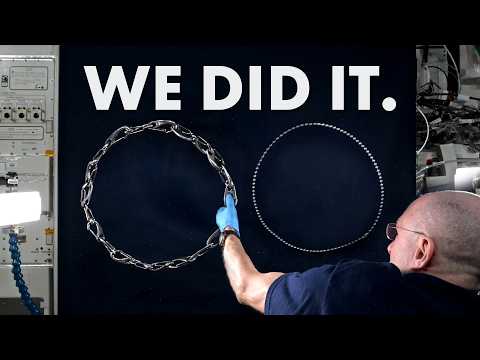
Creating a Non-Circular Shape: The final idea was to form the chain into a loop and then manipulate it into a non-circular shape, such as a rectangle. The expectation was that if the theory held true, the chain would maintain this shape as it flowed through the loop.
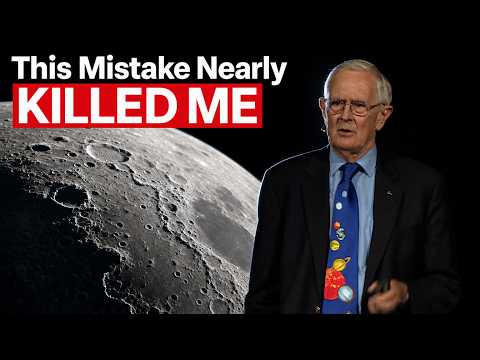
During the experiment, the YouTuber had the unique opportunity to conduct a video call with astronaut Don Petit. This call was facilitated by NASA and allowed for real-time collaboration on the experiment. The technology behind the call was impressive, with minimal lag, showcasing advancements in communication even in space.
As the experiment progressed, the behavior of the chain was observed closely. Despite the initial expectations, the chain began to exhibit unexpected behavior, slowly transitioning towards a circular shape. This led to discussions about the influence of friction at the joints of the chain, which was not accounted for in the initial mathematical analysis.
The experiment revealed several intriguing insights:
This experiment not only tested a scientific theory but also provided a unique glimpse into the complexities of physics in a zero-gravity environment. The collaboration between the YouTuber and astronaut Don Petit exemplified how curiosity and technology can bridge gaps in scientific understanding. The findings from this experiment may lead to further investigations into chain behavior and other phenomena in space, opening new avenues for research and discovery.
The YouTuber expressed gratitude to NASA, Don Petit, and all those involved in making this extraordinary experiment possible. As science continues to evolve, the insights gained from such experiments will undoubtedly contribute to our understanding of the universe and the laws that govern it.