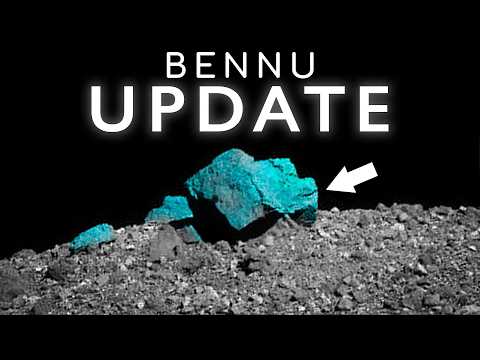
NASA's OSIRIS-REx mission, launched in 2016, traveled to asteroid Bennu to collect pristine samples of regolith and dust. Bennu, a relic from the solar system's formation, holds clues to planetary origins and possibly life. The mission used a touch-and-go mechanism to gather material, avoiding contamination. This unprecedented sample return will help scientists study organic compounds and hydrated minerals, advancing our understanding of the early solar system.
The answers to some of our solar system's oldest mysteries lie locked in dust and ice — asteroids. These time capsules are relics from before Earth was fully formed. If we can uncover what lies within them, we can better understand our own origins.
Asteroids are remnants of some of the oldest objects in our solar system. They were present when everything was in the process of forming around the sun. As such, asteroids can tell us a lot about the formation of the solar system. They are the building blocks of planets and potentially life itself.
Asteroids could be the source of water on Earth and mysteriously contain organic materials like hydrocarbons and amino acids. Studying uncontaminated samples of asteroids provides insights into the universe we live in.
While many meteorites land on Earth and provide samples, these meteorites pass through our atmosphere, heating up to incredible temperatures. This heating alters the delicate materials in the meteorite. Upon impact, they are exposed to Earth's surface, making it difficult for scientists to distinguish what was originally present from what was introduced after impact.
Therefore, a sample directly from an asteroid, protected from contamination during re-entry, can give a much greater insight into the nature of asteroids than anything previously observed.
OSIRIS-REx (Origins, Spectral Interpretation, Resource Identification, Security, Regolith Explorer) is part of NASA's New Frontiers program, alongside missions like Juno and New Horizons. It launched in September 2016 and arrived near asteroid Bennu on December 3, 2018.
Unlike most robotic NASA missions that do not return to Earth, OSIRIS-REx is unique as a sample return mission — the first time NASA attempted this with an asteroid. (Japan's JAXA program had previously done this with the Hayabusa missions.)
NASA's goal was to collect a 60-gram sample of regolith and dust from Bennu's surface. Bennu is an extremely old asteroid, thought to have existed since the birth of the solar system. It is a treasure trove of information about the solar system's formation and possibly the origins of life.
OSIRIS-REx entered Bennu's orbit and began imaging the surface. It then slowly descended, carefully avoiding disturbing or contaminating the asteroid's surface by using thrusters sparingly. The spacecraft drifted gently down, extending its long Touch-And-Go Sample Acquisition Mechanism (TAGSAM).
At the moment it touched the surface, OSIRIS-REx released a burst of nitrogen gas from its arm, kicking up dust and materials. These particles were captured in the sampler.
The collected sample, protected from contamination during re-entry, will allow scientists to search for organic compounds like amino acids, hydrated materials such as clays, and other substances that are otherwise hard to detect.
This unprecedented sample return mission will advance our understanding of the early solar system, the formation of planets, and the potential origins of life on Earth.
NASA's OSIRIS-REx mission represents a monumental step in space exploration and planetary science. By physically collecting and returning samples from asteroid Bennu, the mission opens a new window into the past, offering clues about the building blocks of our solar system and the origins of life itself. The strange substances uncovered on Bennu could reshape our understanding of the universe and our place within it.