Recent observations from NASA's Sphere X Space Observatory have revealed that the interstellar object 3I Atlas is much larger and stranger than previously thought. It emits only carbon dioxide, with no water detected, raising questions about its origin and composition. The findings suggest that 3I Atlas may not be a typical comet or asteroid, leading to speculation about its artificial nature. This blog explores the implications of these discoveries and what they mean for our understanding of 3I
The interstellar object known as 3I Atlas has been a source of intrigue and speculation since its discovery. Recent observations from NASA's Sphere X Space Observatory have provided new insights that challenge our understanding of this enigmatic object. This blog post delves into the latest findings, exploring the implications of its unusual composition and size, and what they might mean for the future of astronomical research.
3I Atlas has been observed multiple times since its entry into our solar system. Initially thought to be a typical comet or asteroid, its characteristics have increasingly suggested otherwise. The Sphere X Space Observatory, designed primarily for studying intergalactic objects, was recently repurposed to analyze 3I Atlas due to its peculiar behavior and composition.
Between August 8 and 12, researchers at the Sphere X Space Observatory made significant observations of 3I Atlas. The findings revealed that:
The emission of only CO2, with a mass loss rate of approximately 70 kg per second, is particularly puzzling. Historically, comets have been observed to emit both CO2 and carbon monoxide (CO) simultaneously. The absence of water and CO in the emissions of 3I Atlas is a significant deviation from known cometary behavior.
The Sphere X Observatory employs spectroscopy, a technique that splits light into various wavelengths to identify chemical compounds. This method has allowed scientists to analyze the composition of 3I Atlas in detail. The lack of a water coma around the object is particularly striking, especially given its proximity to the solar system's water ice line during observations.
To contextualize the findings, it's essential to compare 3I Atlas with other known comets:
The absence of both CO and H2O in 3I Atlas's emissions is unprecedented and raises questions about its classification as a comet.
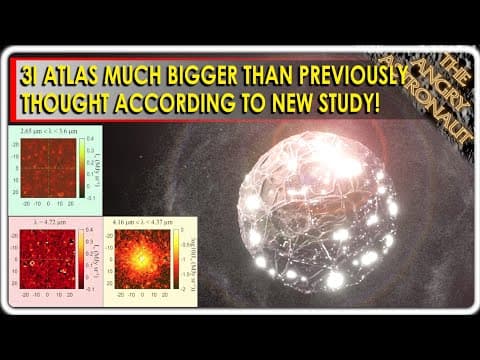
The Sphere X images suggest that 3I Atlas is a point source, indicating that its nucleus is generating light rather than reflecting it. This observation implies that the object is either very large or possesses unique properties that allow it to emit light independently. The estimated diameter of 46 kilometers suggests a mass significantly greater than previous interstellar objects, such as 2I Borisov and 'Oumuamua'.
If 3I Atlas is indeed this massive, it challenges our understanding of the distribution of such large objects in interstellar space. The likelihood of encountering a body of this size is low, given that we should have detected many smaller objects before identifying one of this magnitude.
Given its unusual characteristics, several theories have emerged regarding the origin of 3I Atlas:
Interestingly, the trajectory of 3I Atlas appears to originate from the constellation Sagittarius, an area also associated with the famous WOW signal detected in 1977. While the WOW signal was determined to be a natural phenomenon, the coincidence of these two events invites further investigation into the nature of 3I Atlas.
The findings from NASA's Sphere X Space Observatory have opened up new avenues of inquiry regarding 3I Atlas. Its unusual composition, size, and trajectory challenge our existing frameworks for understanding interstellar objects. As we await further data from the James Webb Space Telescope, the scientific community remains eager to uncover the mysteries surrounding this fascinating object. Whether 3I Atlas is a natural phenomenon or something more extraordinary, it undoubtedly represents a significant chapter in the ongoing exploration of our universe.