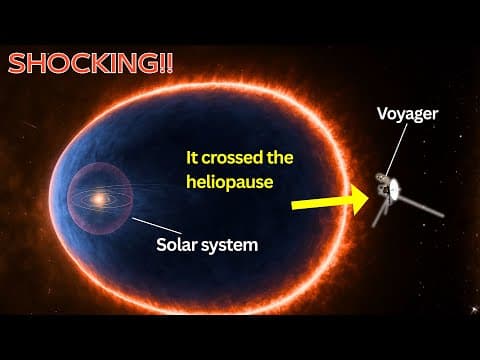
NASA's Voyager 1 and 2 spacecraft crossed the heliopause, the solar system's boundary, revealing a narrow, energetic boundary with unexpected magnetic and particle behaviors. These findings reshape our understanding of the solar system's edge, the heliosphere's protective role against cosmic radiation, and the dynamic interaction between the Sun and the Milky Way, with implications for future space missions and interstellar exploration.
In recent years, NASA's Voyager 1 and Voyager 2 spacecraft have crossed the heliopause, the boundary where the Sun's magnetic influence ends and the surrounding galaxy begins. New analyses of their data are providing scientists with a clearer picture of what exists beyond that boundary, revealing unexpected structures, particle behavior, and magnetic conditions in the space between stars. These findings are reshaping how researchers define the true edge of the solar system and how our Sun interacts with the Milky Way.
This article explores what Voyager discovered at the heliopause, why those results matter, and what they tell us about the environment beyond our solar system.
Voyager 1 and Voyager 2 were launched in 1977 to explore the outer planets. However, their most valuable contributions came decades later, far beyond the orbit of Neptune. As the spacecraft traveled outward, they entered a region where the flow of charged particles from the Sun, known as the solar wind, slows down as it encounters the surrounding interstellar medium.
This interaction forms a vast bubble around the solar system called the heliosphere. The outer boundary of that bubble is the heliopause. When Voyager 1 crossed this boundary in 2012, its instruments recorded a sudden drop in particles coming from the Sun and a sharp increase in high-energy cosmic rays arriving from outside the solar system. These changes confirmed that the spacecraft had moved into interstellar space. Voyager 2 later observed the same transition from a different direction, providing a second, independent set of measurements.
Scientists had expected a wide, chaotic transition region where solar and interstellar particles would mix gradually. Instead, Voyager detected a relatively narrow zone where conditions changed quickly and decisively. On one side, the plasma environment was controlled by the Sun; on the other, it was shaped by the magnetic fields and particles of the Milky Way.
Near this boundary, Voyager also detected a region where solar particles were compressed and heated as they slowed down. This created a layer of high-energy plasma just inside the heliopause. Temperatures and particle densities in this region were much higher than models had predicted, indicating that the interaction between the solar wind and interstellar space is far more energetic than previously assumed.
These measurements turned the heliopause into something more than a conceptual boundary. It is now understood as a physical structure with measurable properties, including thickness, temperature, and magnetic behavior.
The heliopause is not just a line in space; it is part of a protective system that shields the solar system from a significant fraction of high-energy radiation that fills the Milky Way. Galactic cosmic rays, produced by distant supernova explosions and other energetic events, travel through interstellar space at nearly the speed of light. The heliosphere deflects many of these particles, reducing the radiation that reaches the inner planets.
Voyager showed that this shielding effect is sharper and more structured than expected. As the spacecraft crossed the heliopause, the number of galactic cosmic rays increased rapidly while solar particles nearly disappeared. This confirmed that the boundary acts as a filter, separating two very different radiation environments.
Prior models predicted that the Sun's magnetic field and the galaxy's magnetic field would meet at the heliopause at different angles, creating turbulence and twisted field lines. Instead, Voyager found that the magnetic field direction on both sides of the boundary was more similar than expected. This suggests that magnetic fields may be connecting or reorganizing themselves in ways that are not yet fully understood.
Plasma wave instruments also revealed that the density of the interstellar medium is higher than scientists had estimated before Voyager's arrival. This means the Milky Way exerts more pressure on the heliosphere than previously thought, helping to explain why the Sun's protective bubble is compressed in some directions and stretched in others.
Together, these observations indicate that the heliosphere is not a simple, spherical shell. It is shaped by the balance between the solar wind and the surrounding galactic environment, producing a complex magnetized boundary that changes over time. Voyager has provided the first direct evidence needed to test and refine these models, replacing decades of speculation with real data.
Understanding the heliopause has practical consequences. High-energy cosmic radiation is one of the main hazards for astronauts traveling beyond Earth's magnetic field. Missions to the Moon, Mars, and eventually deeper into space will need accurate predictions of radiation exposure.
Voyager's measurements help scientists understand how the heliosphere reduces and reshapes this radiation, improving models used for mission planning.
There are also implications for the long-term history of the solar system. The Sun does not remain in one place within the Milky Way. Over millions of years, it moves through regions of varying density and magnetic activity. If the Sun were to pass through a denser interstellar cloud, the heliosphere could shrink, allowing more cosmic radiation to reach the inner planets.
Voyager's data provide the first direct insight into how that interaction might unfold.
These discoveries have strengthened the case for a new interstellar mission. Voyager's instruments were designed more than four decades ago; yet they have revealed that the region beyond the heliopause is scientifically rich.
A future probe equipped with modern sensors could map the interstellar medium in far greater detail, measuring magnetic fields, particle flows, and chemical composition across a wide range of distances.
For now, Voyager continues its journey. Engineers are gradually shutting down non-essential systems to preserve power, allowing the spacecraft to keep transmitting data for as long as possible. Each signal sent back from beyond the heliopause adds to our understanding of a region of space that had never been directly sampled before.
Voyager has revealed that the true edge of the solar system is a magnetic boundary, not a distant planet. Beyond it lies a structured and active interstellar environment shaped by the Milky Way. For the first time, humanity is directly measuring the space between the stars.
The Voyager missions have transformed our understanding of the solar system's boundary and the interstellar environment. Their discoveries highlight the dynamic and complex nature of the heliopause and the protective role of the heliosphere against cosmic radiation. As Voyager continues to send back invaluable data, it paves the way for future exploration beyond our solar system, deepening our knowledge of the universe we inhabit.