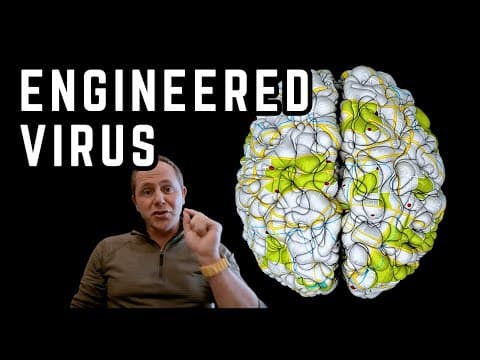
A groundbreaking neuroscience study used a modified rabies virus to map how psilocybin, the active compound in magic mushrooms, physically rewires the brain. The research reveals that psilocybin strengthens sensory connections while weakening brain regions tied to fear, anxiety, and self-identity, offering unprecedented insight into consciousness, trauma healing, and the potential to program brain plasticity during psychedelic experiences.
Something monumental has just occurred in the field of neuroscience—an achievement that once seemed impossible. Researchers have taken the deadliest virus known to humanity and ingeniously repurposed it to observe, in real time, how psilocybin (the active compound in magic mushrooms) physically repairs the brain down to the exact neurons involved. This discovery fundamentally changes our understanding of consciousness, identity, trauma, and even what it means to be human.
Since 2021, scientists have known that psilocybin promotes the growth of new connections between neurons—millions of them—that can last weeks or even become permanent. However, the precise locations and pathways of these new connections remained a mystery. We knew the brain was building new "roadways," but not which "cities" these roads connected.
To solve this puzzle, researchers from Cornell and the Allen Institute turned to an unlikely tool: the rabies virus. Known for its deadly effects and ability to travel backward through the nervous system, the rabies virus naturally jumps from one neuron to every neuron that sends signals to it, tracing upstream neural pathways.
Scientists engineered a modified version of this virus that only jumps one neuron at a time, deleted the gene responsible for its lethal replication, and added a green fluorescent marker. This transformed the virus from a deadly pathogen into a biological neon green highlighter, capable of illuminating neural circuits involved in physiological and psychological healing.
The study involved several key steps:
Using light sheet microscopy, the researchers sliced the brains into unimaginably thin sections and photographed every slice, generating millions of images. They then counted every green-highlighted neuron—over 500,000 inputs per brain—mapping each to its exact location across 316 brain regions. This was the first complete map of how psilocybin rewires the brain.
Contrary to expectations of randomness, the rewiring followed a highly specific and statistically improbable pattern (p = 0.00006). The connections that strengthened by over 10% were primarily sensory regions, including:
This strengthening explains why the world feels more vivid during a psilocybin experience—the brain literally reconnects more strongly to the external world.
Conversely, connections that weakened by up to 15% were located in brain regions responsible for our internal narrative and self-identity, such as:
In plain terms, psilocybin temporarily quiets the brain regions that generate our sense of self, fears, memories, and internal loops. This includes the default mode network, often associated with depression, which loses its grip during the experience. This neural quieting is why people often report feeling like the world is new and different.
One of the most astonishing parts of the study involved chemically silencing a single brain region during the psilocybin session. The silenced region did not undergo rewiring, but all other active regions did. This demonstrated that the brain's rewiring is not random but context- and experience-dependent—it is programmable.
Essentially, the study proves that when the brain grows new connections, it becomes what it pays attention to. This insight has profound implications:
This breakthrough marks a massive threshold in neuroscience. For the first time, scientists are not just observing brain changes—they are watching what the brain is becoming. The brain and mind are not fixed but dynamic and evolving.
The study provides a real-life blueprint of the neural circuitry involved in transformative experiences, such as healing from trauma or PTSD in a single session. By mapping these circuits neuron by neuron, researchers can now design and potentially control the brain's rewiring.
This raises both hopeful and cautionary points:
The study challenges the notion of consciousness as a static property. Instead, consciousness emerges from dynamic neural networks that can be turned up or down. Personality, memories, fears, and reactions are not as permanent as they seem.
This realization is both liberating and unsettling. It suggests that identity is fluid and can be engineered, raising ethical questions about control and influence during psychedelic experiences.
This groundbreaking research reveals how psilocybin physically rewires the brain, strengthening sensory connections while weakening those tied to fear and self-identity. The use of a modified rabies virus as a neural tracer has allowed scientists to map these changes with unprecedented precision.
The findings open new frontiers in neuroscience, therapy, and our understanding of consciousness. They highlight the power and responsibility inherent in guiding attention during psychedelic states, as this can shape the very essence of who we are.
As we continue to explore the brain's prediction engine and the mechanisms behind these transformative experiences, the implications for healing, identity, and consciousness will only deepen. This study is a monumental step toward unlocking the mysteries of the human mind and harnessing its incredible plasticity.