
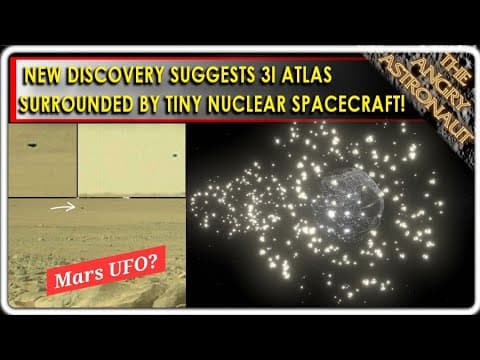
Recent studies of the interstellar object 3I 'Atlas' reveal unusual features such as high deuterium levels, water production in its coma, an anti-tail defying solar wind, and nickel and methanol presence. These anomalies suggest it may be a fusion-powered starship with a swarm of nano drones, supported by coinciding UFO sightings on Mars and precise Jupiter flyby maneuvers, challenging natural comet explanations.
What if the third confirmed interstellar object to ever visit our solar system isn't a comet but a starship? A modified asteroid powered by fusion, trailing a cloud of tiny fusion-powered drones or nanomachines manufacturing water, methanol, and other substances right before our telescopes? This intriguing hypothesis has been gaining traction, especially with new data emerging about 3I 'Atlas'.
3I 'Atlas' is the third confirmed interstellar object detected passing through our solar system. Unlike typical comets, it exhibits a series of bizarre and unprecedented anomalies that challenge natural explanations. Despite previous claims of a "final chapter" on this object, new data and studies have opened a new beginning in understanding its nature.
Astrophysicist Avi Lo, former chair of Harvard's astrophysics department, has highlighted that the water vapor in 3I 'Atlas's coma has a deuterium-to-hydrogen ratio roughly ten times higher than any natural comet measured in our solar system or beyond. This ratio is about one deuterium atom for every 100 hydrogen atoms, far exceeding typical cometary or interstellar cloud values.
A recent study using China's Tianma telescope revealed that up to 80% of the deuterium-rich water before perihelion is not emanating from the nucleus, as expected in natural comets, but from icy grains and dust particles scattered throughout the coma. This suggests an unusual, distributed water release mechanism defying standard cometary models.
Hubble images show a massive sunward-pointing structure composed of large particles that resist or are actively propelled against solar radiation pressure and solar wind, which normally push particles away from the sun. This anti-tail is not explained by natural dust behavior.
Spectroscopic data reveal extreme nickel production in the coma at distances too cold for natural metal vaporization. Nickel-to-iron ratios are unusually high, with nickel atoms dominating the spectrum. Additionally, the ALMA observatory detected exceptionally high methanol levels, with methanol-to-hydrogen cyanide ratios between 70 and 120, originating from both the nucleus and coma.
Deuterium (heavy hydrogen) is a premium fuel for fusion reactors. Fusion propulsion involves fusing deuterium nuclei to release massive energy, far more efficient than chemical rockets. NASA, DARPA, and private companies have been developing direct fusion drive concepts for decades.
An asteroid hollowed out and reinforced with nickel-iron, loaded with deuterium ice, could serve as a radiation-shielded, self-repairing starship capable of interstellar travel. The coma acts as an exhaust plume and protective swarm of fusion-powered drones or nanomachines.
Coinciding with 3I 'Atlas's close approach to Mars, multiple UFO sightings have been reported, including images from the Perseverance rover showing objects crossing the Martian sky and fast-moving black objects. These could be fusion-powered probes deployed from 3I 'Atlas'.
On March 16th, 3I 'Atlas' passed Jupiter at a distance of 53.445 million km, nearly a perfect intersection with Jupiter's Hill radius (53.502 million km). This suggests a deliberate course correction or targeting burn, possibly to deploy probes into stable orbits around Jupiter's moons for long-term study or resource gathering.
While some dismiss these ideas as wild speculation, Avi Lo, a respected astrophysicist, continues to publish detailed analyses supporting the artificial hypothesis. The anomalies observed require multiple unprecedented natural processes to occur simultaneously, making the fusion-powered starship explanation the simplest and most logical.
3I 'Atlas' challenges our understanding of interstellar objects. Its unusual chemical composition, water production mechanisms, anti-tail, and associated UFO sightings suggest it may be an advanced fusion-powered starship surrounded by a swarm of nuclear probes. As it continues outbound through the solar system, ongoing observations may provide further insights into this extraordinary visitor.
Is this the smoking gun for extraterrestrial technology, or are we seeing aliens everywhere? The data continues to unfold, and the story of 3I 'Atlas' is far from over.
Stay tuned for more updates on this fascinating cosmic mystery.



















