Recent fossil discoveries, including the 146,000-year-old 'Dragon Man' skull from China, challenge previous understandings of human evolution. These findings suggest that Homo sapiens may be more closely related to the Denisovans than Neanderthals, pushing back our origins to over a million years ago and revealing a more tangled human family tree with multiple species coexisting.
One of the biggest mysteries in human evolution has recently been addressed, but in doing so, it has opened up new questions and challenges to our understanding of human origins. New fossil evidence, particularly from China, is reshaping the story of where we come from and who our closest relatives are.
For years, scientists have been trying to answer fundamental questions about human origins: Who were the mysterious Denisovans? Where did we come from? The 21st century has revealed that the human family tree is far more tangled and diverse than previously imagined. Multiple human species often lived simultaneously, sometimes even in the same locations. Around 300,000 years ago, when Homo sapiens appeared, there were as many as six or more other human species sharing the world.
A groundbreaking discovery was made with a 146,000-year-old skull unearthed in Harbin, China, nicknamed "Dragon Man." This skull is large and robust, even more so than Neanderthals, and presents a mixture of features that challenge previous classifications.
The story of Dragon Man dates back to World War II, when a man in Japanese-occupied China found the skull and hid it in a disused well to protect it. It remained hidden for about 80 years until it was rediscovered and studied, leading to the identification of a new species: Homo longi, or Dragon Man.
In 2010, a tiny finger bone was found in Denisova Cave in Russia. DNA analysis revealed it was neither Neanderthal nor Homo sapiens but a new human species, the Denisovans. This was the first time a new human species was discovered through DNA rather than fossils.
Despite sequencing the Denisovan genome, scientists had very few fossils to study—just a finger bone and a few teeth. Later, a small jawbone found in Tibet was also identified as Denisovan through DNA analysis.
The Dragon Man skull's DNA was successfully extracted in 2025, confirming that Homo longi is indeed Denisovan. This discovery finally gave a face to the Denisovans, revealing a large brain with a mixture of Neanderthal-like and Homo sapiens-like features.
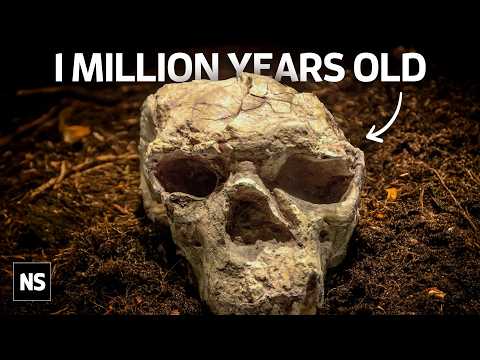
Another ancient skull, Yangjian 2, about 1 million years old and found in China, was reconstructed using CT scans. This skull is not Homo erectus as previously assumed but suggests a different lineage. This finding, combined with the Dragon Man and other fossils, suggests that Denisovans may be more closely related to Homo sapiens than Neanderthals are.
This challenges the long-held belief that Neanderthals and Homo sapiens are sister species. Instead, Denisovans might be our closest relatives, implying that Neanderthals are more distantly related than previously thought. This is controversial because genetic data does not fully support this yet.
The common ancestor of Homo sapiens, Denisovans, and Neanderthals, sometimes called "Ancestor X," may have lived over a million years ago. This pushes back the timeline for the origin of modern humans, suggesting we may be much older than the previously estimated 300,000 years.
Some scientists even propose that this common ancestor originated not in Africa but in Asia, based on the age and location of the Yangjian fossil. This is a highly debated and controversial claim.
Denisovans appear to have been a diverse and adaptable group. They lived in a range of environments, from the cold winters of Harbin to the high altitudes of the Tibetan Plateau, where they hunted a variety of animals and possibly made clothes from animal skins.
Archaeological sites like Denisova Cave in Russia have yielded hundreds of stone tools and exquisite jewelry, although it is unclear whether Denisovans or Homo sapiens made the jewelry. The Bashia Cast Cave on the Tibetan Plateau, inhabited only by Denisovans, provides clearer evidence of their behavior, including fire use and hunting.
Despite multiple human species coexisting around 100,000 years ago, only Homo sapiens survive today. Scientists continue to investigate why we are the last remaining human species. Was it luck, superior adaptation, or some other factor?
These discoveries highlight how much we still do not know about human evolution. Each new fossil can dramatically change our understanding. More fossils and data are needed to resolve conflicts between genetic and morphological analyses and to better understand our origins.
Recent finds in Morocco of early Homo sapiens fossils about 750,000 years old may support the idea of an older origin for our species. Additionally, fossils from Africa and Spain, some over a million years old, await further analysis.
The discovery of Dragon Man and the ongoing research into Denisovans are reshaping the story of human evolution. They suggest a more complex and ancient origin for Homo sapiens and challenge long-held beliefs about our closest relatives. As new fossils are uncovered and technologies improve, our understanding of who we are and where we come from will continue to evolve.
The quest to uncover our past is far from over, and each discovery brings us closer to answering the profound questions about human identity and survival.
Stay curious and keep exploring the fascinating story of human evolution.