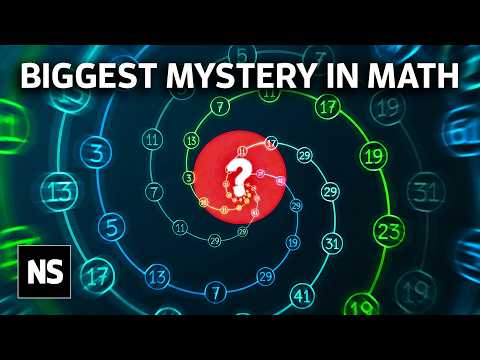
The Riemann Hypothesis, a 160-year-old unsolved problem in mathematics, suggests a hidden order in the distribution of prime numbers. Despite extensive computational evidence supporting it, a formal proof remains elusive. Recent breakthroughs and connections to quantum physics hint at a deeper unity between mathematics and the physical universe, with vast implications for encryption, randomness, and number theory.
For over 160 years, mathematicians have grappled with a deceptively simple yet profoundly complex puzzle about prime numbers. This puzzle, known as the Riemann Hypothesis, is often called the biggest unsolved mystery in mathematics. It promises a $1 million reward for anyone who can finally prove it true or false.
Prime numbers are the fundamental building blocks of all whole numbers. Every number can be uniquely broken down into primes, much like atoms form molecules. Examples of prime numbers include 2, 3, 5, 7, and 11. Despite their fundamental nature, primes appear scattered seemingly at random, with no obvious pattern.
However, when viewed from a broader perspective, a hidden order seems to emerge. In 1859, German mathematician Bernhard Riemann proposed that this hidden order is governed by a single rule connecting all prime numbers to a mysterious formula. Since then, mathematicians have tested his claim extensively, verifying trillions of cases with supercomputers, all consistent with Riemann's prediction.
Yet, verifying cases is not the same as proving the hypothesis true forever. A formal proof remains elusive, and its discovery would revolutionize our understanding of mathematics, encryption, randomness, and even quantum physics.
Every whole number has a unique prime factorization. For example, 12 can be factored into 2 * 2 * 3, all primes. This theorem highlights the importance of primes as the "atoms" of arithmetic.
Carl Friedrich Gauss, as a teenager, noticed that although primes appear scattered, their overall frequency follows a simple rule: as numbers grow larger, primes become less frequent roughly inversely proportional to the logarithm of the number. This insight was formalized as the Prime Number Theorem.
However, this rule is not exact. Tiny discrepancies or "wiggles" exist between the predicted and actual counts of primes, which is where the mystery deepens.
Bernhard Riemann approached the problem differently by studying a complex function now called the Riemann Zeta function. This function encodes the subtle differences between the predicted and actual distribution of primes.
Imagine a graph that steps up by one each time you reach a prime number. This is the prime counting function, denoted as ( \pi(x) ), which counts how many primes are less than or equal to ( x ).
This function is jagged and irregular, making it difficult to find a smooth formula that describes it.
Inspired by physics, mathematicians considered breaking down this jagged function into smooth oscillations or waves, similar to how complex sounds can be decomposed into pure tones.
Riemann discovered that the zeros of the zeta function (values where the function equals zero) govern these oscillations. These zeros come in two types:
The Riemann Hypothesis claims that all non-trivial zeros lie exactly on the "critical line" where the real part equals 1/2.
If all zeros lie on this line, the distribution of primes is not random but constrained by an underlying harmony. The zeros act like harmonies shaping the "music" of the primes, controlling their irregularities.
In 2000, the Clay Mathematics Institute listed the Riemann Hypothesis among seven Millennium Prize Problems, offering $1 million for a correct proof.
In 2018, Sir Michael Atiyah claimed to have a proof, linking the hypothesis to the fine structure constant in physics. However, after rigorous review, the proof was found flawed.
In 2024, Maynard and Guth made a significant breakthrough by showing that if any zeros lie off the critical line, they must be extremely rare. They constructed a mathematical object sensitive to zeros off the line and demonstrated that such zeros would cause unlikely spikes, implying their scarcity.
While not a full proof, this result narrows down the possibilities and advances our understanding of the problem.
The Riemann Hypothesis is not just a number theory problem; it has deep connections to physics.
These insights suggest a profound link between prime numbers and quantum physics, hinting that primes might behave like atoms in a physical system.
A proof would be transformative:
Mathematician Peter Sarnak likened the hypothesis to a bulldozer that could clear many obstacles in mathematics.
The Riemann Hypothesis remains unsolved, but the journey to understand it has reshaped mathematics and inspired new connections across disciplines.
Its resolution would not only solve a famous puzzle but also illuminate the hidden order in apparent chaos, revealing the beauty and harmony woven into the fabric of mathematics and the universe.
For those fascinated by the limits of mathematics and the nature of infinity, exploring related topics like the busy beaver numbers offers even deeper insights into what can and cannot be proven.
The quest to understand prime numbers continues to challenge and inspire, promising discoveries that could change how we perceive numbers, nature, and reality itself.