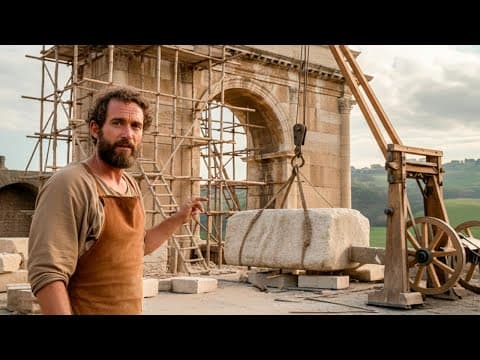
This blog explores nine ancient technologies that challenge modern engineering, showcasing how ancient methods for heating, cooling, and construction were often more efficient and sustainable than today's solutions. From the Roman hypocaust to the Persian wind catchers, these innovations reveal a deep understanding of natural forces and materials that we can learn from today.
What if I told you that a building technique from 2,000 years ago could outlast anything we build today? That ancient people stayed comfortable in 120° heat without spending a single dollar on electricity? That one person using nothing but rope and wood could lift what would take 60 modern workers? You might think, "Sure, but it was primitive, slow, inefficient." But what if we got that backwards? What if ancient technology wasn't just good for its time? What if it was actually better? Today, we're looking at nine technologies that challenge everything we think about progress. The real question is, what did they understand that we've completely forgotten?
Let's start in ancient Egypt, focusing not on a structure, but on a tool that completely changed our relationship with fire: the bellows. This seemingly simple invention, dating back to 1500 BC, was a quantum leap in heating technology. A bellows is essentially a primitive air pump that dramatically increases the oxygen supply to a fire. This results in a fire that burns hotter, cleaner, and more efficiently. For metal workers, this meant they could finally achieve the high temperatures needed to smelt metals. For heating, it allowed for more warmth from the same amount of fuel, reducing smoke and improving air quality indoors. The principle of using forced air to enhance combustion is the foundation of modern heating systems, showing that ancient Egyptians were manipulating the chemistry of fire long before we did.
Next, we travel to Rome, where one of the most luxurious inventions was the hypocaust system, perfected around the 1st century BCE. This ingenious method involved raising a room's floor on pillars to create a hollow space underneath, where hot air from a furnace would circulate. This system not only heated the floors but also warmed the walls through hollow tiles, creating a comfortable environment. The hypocaust was a status symbol, but it also demonstrated a sophisticated understanding of heat distribution and comfort that modern radiators often fail to replicate. However, it required significant labor and resources, making it accessible only to the wealthy.
While the Romans were heating their villas, Koreans were developing the ondol system, which has been in continuous use for over 2,000 years. The ondol ingeniously integrated heat from cooking fires into the home’s heating system. Smoke and hot air from the kitchen would be channeled under the floor, warming thick stone slabs that radiated heat for hours. This system was not only efficient but also shaped daily life in Korea, as families would gather on the warm floors. Modern adaptations of the ondol still exist today, showcasing its enduring practicality.
In northern China, the kang, or heated bed stove, emerged as a vital piece of thermal engineering. This raised platform, connected to a cooking stove, allowed families to cook and heat their living space simultaneously. The kang's design maximized thermal mass, absorbing heat from cooking and releasing it slowly throughout the night. This efficiency reduced the need for firewood, making it essential for survival in harsh climates. The kang exemplifies how ancient cultures innovated to meet their environmental challenges.
In the scorching deserts of Persia, ancient engineers devised wind catchers, or badgirs, to provide passive cooling. These tall towers captured breezes and funneled them into homes, creating a natural airflow that significantly lowered indoor temperatures. Some designs even utilized underground aqueducts to enhance cooling through evaporative processes. This ingenious system demonstrates a profound understanding of natural airflow and thermal dynamics, offering a sustainable solution to extreme heat that modern air conditioning systems often fail to match.
Across various cultures, ancient builders recognized the importance of thermal mass in construction. Thick walls made from adobe, rammed earth, or stone acted as climatic batteries, absorbing heat during the day and releasing it at night. This principle was crucial for maintaining comfortable indoor temperatures in regions with extreme temperature fluctuations. Modern architects are now rediscovering the benefits of thermal mass, using materials that regulate temperature passively, proving that ancient wisdom can inform contemporary design.
Ancient urban planners understood that the simplest way to combat heat was to create shade. Cities in the Middle East and Mediterranean were designed with narrow streets and tall buildings that cast deep shadows, creating cooler microclimates. Central courtyards in homes provided shaded areas that facilitated natural ventilation, allowing hot air to escape while drawing in cooler air. This design philosophy highlights the importance of urban planning in climate control, a lesson that modern cities often overlook.
The durability of Roman concrete structures, some of which still stand today, raises questions about modern construction practices. Roman engineers used volcanic ash to create a self-healing concrete that actually improves over time. This sustainable material contrasts sharply with modern concrete, which deteriorates quickly and requires constant maintenance. The Romans' understanding of materials science and their ability to create long-lasting structures offers valuable insights for contemporary builders facing climate challenges.
Finally, we encounter the Baghdad battery, a small clay jar that may represent an ancient understanding of electricity. Dating back to the Parthian period, this device could potentially generate a galvanic current when filled with an acidic liquid. If true, this discovery suggests that ancient civilizations may have explored electrical principles long before modern science. The implications of this find challenge our understanding of technological development and highlight the innovative spirit of our ancestors.
The exploration of these nine ancient technologies reveals a profound understanding of natural forces and materials that modern society often overlooks. From efficient heating and cooling systems to durable construction methods, ancient engineers demonstrated ingenuity that remains relevant today. As we face contemporary challenges, the lessons learned from these ancient practices can guide us toward more sustainable and efficient solutions. The next time you consider modern technology, remember the wisdom of the past and the timeless principles that continue to shape our world.