
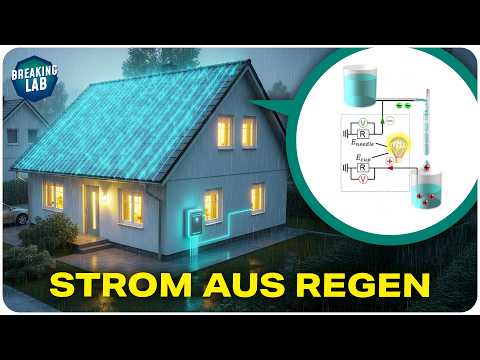
A research team from Singapore has developed a groundbreaking method to generate electricity from falling raindrops, claiming to produce 100,000 times more energy than previous techniques. This innovative approach utilizes the 'Plug Flow' principle, overcoming significant physical challenges in energy conversion. The potential for decentralized, eco-friendly energy generation from rainwater could transform how we harness renewable resources, especially in rain-rich regions like Germany.
Every year, hundreds of liters of rain fall on German homes, much of which goes unused. What if we could convert these raindrops into electricity using a technique previously deemed impossible? A research team from Singapore claims to have achieved this, stating they can generate 100,000 times more electricity than previous methods. This blog post explores the innovative approach and the physics behind it.
Hydropower is one of humanity's oldest success stories, providing a powerful and efficient form of green energy for thousands of years. In Germany alone, over 7,300 hydropower plants contribute approximately 20 terawatt-hours of electricity annually, accounting for about 12% of the country's renewable energy. However, the potential for further expansion is nearly exhausted, with most suitable rivers already utilized and new projects facing environmental restrictions. While there is an estimated unused potential of around 14.7 terawatt-hours per year, most of it cannot be realized due to regulatory issues.
Germany experiences an average annual rainfall of 902 mm, making it one of the rainiest countries in Europe. With countless rooftops collecting this rainwater, the question arises: why not harness this resource for electricity generation? The Singaporean research team has developed a technique to generate electricity from falling raindrops, utilizing a simple yet ingenious method.
It is known that when water flows over a solid surface, electrical charge separation occurs at the interface. This phenomenon, known as the surface effect, involves the ionization of water molecules into positively charged hydrogen ions (H+) and negatively charged hydroxide ions (OH-). When water flows through a narrow channel, these ions can be separated, creating a potential difference that can generate electricity.
Previous attempts to harness this energy involved using tiny channels, or nanorods, to maximize surface area for charge separation. However, two significant physical challenges arose:
The Singaporean researchers have overcome these challenges with a new principle called the Plug Flow principle. The setup is surprisingly simple:
Instead of a continuous stream, the water forms a series of droplets separated by air bubbles, creating a unique flow pattern. This pattern allows for effective charge separation at each water-air interface, significantly enhancing energy conversion efficiency. The researchers measured the electrical output using electrodes connected to both the metal needle and a collection cup at the bottom.
The researchers achieved an energy conversion efficiency of over 10%, meaning more than one-tenth of the potential energy of the water is converted into electrical energy. With a flow rate of 80 ml per minute through a 32 cm long tube with a 2 mm diameter, they recorded an average electrical output of 440 microwatts. The power density can reach up to 100 watts per square meter, making this method robust against water impurities and temperature fluctuations, relying solely on gravity for operation.
While the Plug Flow principle presents exciting possibilities for decentralized and eco-friendly energy generation, it also faces challenges:
The researchers suggest that an optimally designed Plug Flow generator could achieve a power density of around 100 watts per square meter. In contrast, modern solar panels can produce over 200 watts per square meter under ideal conditions. However, solar panels can still generate electricity during rain, albeit at reduced efficiency. Thus, the rainwater system could serve as a complementary technology to solar energy, enhancing overall energy production.
The cost of implementing this technology poses a significant challenge. The materials for the tubes, primarily made from FEP, are relatively inexpensive, but the overall installation costs could be substantial. A rough estimate suggests that a 10 m² installation could cost around €25,000 just for materials, compared to €2,500 to €3,000 for a solar panel system of the same size. However, as seen with solar technology, prices can decrease significantly over time.
The innovative approach to harnessing energy from rainwater through the Plug Flow principle is a fascinating development in renewable energy technology. While it presents unique advantages and potential for decentralized energy generation, it also faces practical challenges that need to be addressed. As research continues, this method could become a valuable addition to our renewable energy toolkit, especially in regions with abundant rainfall. The future of energy generation may very well include both solar and rainwater technologies working in tandem to create a more sustainable world.



















