Roger Penrose reveals that the traditional particle view of matter is fundamentally wrong. Instead, reality consists of quantum fields filling all space, with particles as temporary excitations or patterns in these fields. This perspective resolves many quantum mysteries and suggests spacetime and particles are emergent phenomena from deeper structures like twistor space. Ultimately, we are complex, transient patterns in universal quantum fields, not separate solid objects.
Most of us grow up thinking that we are made of particles—tiny solid objects like atoms, electrons, and quarks. This intuitive picture, taught in schools and textbooks, portrays the universe as composed of discrete, billiard-ball-like particles interacting through forces. However, Roger Penrose, a renowned physicist and mathematician, challenges this fundamental assumption. He explains that there are no particles in the traditional sense; instead, everything, including you, is made of quantum fields that fill all of space.
Penrose begins by urging us to stop thinking of ourselves as collections of particles. The classical image of electrons orbiting nuclei and quarks inside protons is misleading. Particles, as we understand them, never truly existed as independent entities. Instead, the universe is composed of quantum fields—continuous entities that exist everywhere in space.
In the 1920s, physicists discovered wave-particle duality: light sometimes behaves like a wave and sometimes like a particle (photons), and electrons sometimes behave like waves. This duality was a famous mystery, but the resolution was not that particles are both waves and particles simultaneously. That was a confused compromise.
The real solution, developed in the 1930s and 40s, is quantum field theory (QFT). QFT states that there are no particles, only fields. Every type of particle corresponds to a quantum field that permeates the entire universe. For example, there is an electron field, a quark field, and a photon field, all filling space continuously.
A field is a quantity defined at every point in space. For example:
In QFT, particles are localized excitations or ripples in these fields. They are not independent objects but patterns or knots in the underlying field.
Penrose compares particles to waves on the ocean. Waves are not separate substances; they are patterns in the water. Similarly, an electron is a stable ripple in the electron field. The field is fundamental; the particle is a temporary pattern.
Understanding that particles are excitations of fields explains many quantum phenomena:
Empty space, or vacuum, is not truly empty. Quantum fields are always present and fluctuate even when no particles are detected. These quantum fluctuations cause virtual particles to appear and disappear briefly, borrowing energy from the vacuum.
The Casimir effect demonstrates that quantum fluctuations have measurable consequences. Two metal plates placed close together in a vacuum experience a force due to differences in quantum field fluctuations between and outside the plates.
QFT is the most successful physical theory ever, predicting experimental results with extraordinary precision. However, it is mathematically complicated and plagued by infinities in calculations. Physicists use a technique called renormalization to subtract these infinities and obtain finite, accurate results.
Renormalization works but is philosophically unsatisfying. It suggests that our current understanding is incomplete, especially because it assumes spacetime is continuous and infinitely divisible.
Penrose argues that spacetime itself is not fundamental but emergent from a deeper structure. At the Planck scale (about 10^-35 meters), spacetime breaks down. He proposes twistor theory as a framework where spacetime and fields emerge from a more abstract space.
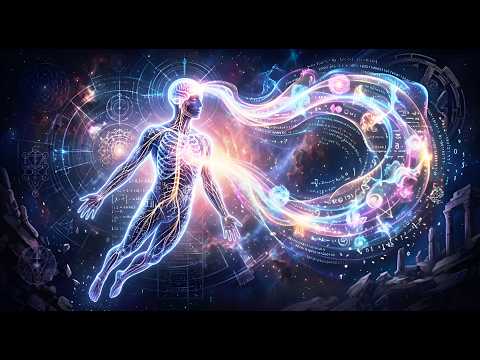
Your body, composed of approximately 7 x 10^27 atoms, is not a collection of solid objects but a complex pattern of excitations in multiple quantum fields:
You are a temporary, stable knot in the universal quantum field structure—a pattern of music rather than a collection of things.
The fields that make up your body are the same fields that make up everything else in the universe. The electron field in your brain is the same as that in distant stars or galaxies. At the deepest level, you and everything else are patterns in the same underlying reality.
This resonates with ancient mystical ideas that "all is one." Quantum field theory vindicates this by showing there is only one reality—the quantum fields—and everything is a pattern within this unity.
The ancient Buddhist concept of Anatta, or non-self, aligns with this scientific understanding. There is no permanent, separate self—only temporary patterns in an eternal process. You are not a thing with an unchanging essence but a transient configuration in the eternal quantum fields.
Roger Penrose's explanation transforms our understanding of reality. We are not made of particles or solid things but of quantum fields—vibrating, fluctuating, and organizing into complex patterns. The universe is an eternal symphony of fields, and we are beautiful, temporary melodies within it. This profound insight bridges physics, philosophy, and spirituality, revealing the deep interconnectedness of all existence.
You are not separate. You never were. You are the universe experiencing itself for a brief moment before dissolving back into the eternal field structure from which all patterns emerge and to which all patterns return.