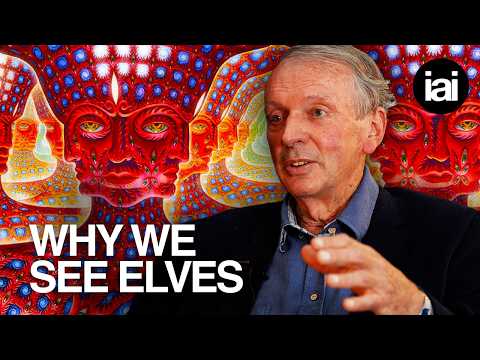
Rupert Sheldrake discusses the cultural and metaphysical aspects of psychedelic experiences, including visions of elves on DMT, the debate between perennialism and contextualism, the role of morphic resonance, and the current psychedelic renaissance's impact on medicine and spirituality.
Psychedelic experiences have fascinated humanity for decades, often revealing vivid visions and profound insights. One intriguing phenomenon is the common vision of elves, goblins, and other mythical beings reported by users of DMT, a powerful psychedelic. Rupert Sheldrake, a biologist and author, offers a thought-provoking perspective on this and other aspects of psychedelic experiences.
Sheldrake recounts an experiment where Claudia Nuranho, a psychotherapist, gave ayahuasca (a psychedelic brew) to middle-class people in Chile and Santiago who had no prior knowledge of Amazonian jaguar cults. Remarkably, these individuals experienced visions of jaguars and related imagery. This suggests that such visions are not merely the result of brain molecules reacting to dimethyltryptamine (DMT) but may involve picking up on a collective memory through what Sheldrake calls "morphic resonance."
Morphic resonance is the idea that there is a collective memory in nature, a resonance from similar systems in the past to the present. Thus, when people consume ayahuasca, their brains may resonate with the culturally impregnated experiences of others who have taken it before, even if they come from different cultures.
Sheldrake discusses a debate from the 1960s that is gaining renewed interest: perennialism versus contextualism.
Perennialism posits that there is one ultimate mystical experience transcending all cultures and religions. The differences lie only in interpretation. For example, one person might interpret the experience through Christianity, another through Buddhism, but the core experience is the same.
Contextualism argues that culture and personal background fully determine the psychedelic experience. For instance, Westerners might see Jesus or biblical imagery, while indigenous Americans might see jaguars or serpents.
Sheldrake believes that some aspects of psychedelic experiences transcend culture, taking individuals beyond their cultural frameworks. He shares his own experience with LSD in 1971, which was outside the mechanistic and atheistic worldview he had been taught.
A key question is how to distinguish between hallucinations and genuine access to metaphysical realms. Sheldrake approaches this through his theory of morphic resonance and the idea of collective memory.
He draws parallels with dreams, where people encounter improbable and hallucinatory experiences. For example, the Hindu god Ganesh, an elephant-headed deity, appears frequently in the dreams of many Indians, despite being a cultural image rather than a physical entity. This suggests that such figures are part of a collective imagination and may manifest in dreams and psychedelic experiences as archetypes or manifestations of deeper principles.
The common vision of elves, goblins, and fairies during psychedelic experiences, especially with DMT, is a mysterious phenomenon. These entities appear across cultures, including Western and Amerindian cosmologies.
Sheldrake suggests that whether these beings are autonomous entities in a psychic or imaginal realm remains an open question. However, their consistent appearance points to a shared cultural or archetypal phenomenon rather than random hallucinations.
Sheldrake attributes the current resurgence of interest in psychedelics to their ability to open people's minds to a larger realm of consciousness. For many, psychedelics serve as a rite of passage from a narrow materialist worldview to a broader understanding of mind and reality.
There is a growing trend to medicalize psychedelics, turning them into patentable medicines for treating conditions like depression and PTSD. Sheldrake acknowledges this but emphasizes that psychedelics themselves will not disappear; natural sources like magic mushrooms will remain accessible.
He highlights that the curative effects of psychedelics are not solely due to their chemical action on the brain but also the profound experiences they induce, which foster a sense of connection, meaning, and unity.
Sheldrake discusses the philosophical challenge of mental causation—the idea that experiences and mental states can cause physical effects. He notes that the placebo effect in medicine is a clear example of mental causation, where beliefs and expectations influence healing outcomes.
This supports the notion that the psychedelic experience itself, beyond the chemical, plays a crucial role in therapeutic effects.
Looking ahead, Sheldrake envisions several models for psychedelic use:
He believes that as scientific understanding grows and the dangers of psychedelics are reassessed, such practices will become more accepted and widespread.
Sheldrake identifies two primary reasons for the current psychedelic renaissance:
Rupert Sheldrake's insights reveal that psychedelic experiences, including visions of elves on DMT, are complex phenomena influenced by culture, collective memory, and possibly metaphysical realities. The ongoing psychedelic renaissance is reshaping medicine, spirituality, and culture, offering new ways to understand consciousness and human experience.
As Sheldrake eloquently puts it, psychedelics are enrichers of life, much like music, providing depth and meaning beyond the ordinary.
Thank you for exploring this fascinating topic with us.