This article explores the relationship between science and religion regarding the concept of sacredness. It traces the historical evolution from animism, where gods were part of nature, to monotheistic religions that separate God from materiality, and finally to science, which removes the divine from the material world entirely. The discussion highlights how science extends the religious trend of abstracting sacredness away from the physical world.
At first glance, science and religion might seem to be fundamentally opposed, especially regarding their views on sacredness and the nature of the universe. Science is often seen as a revolutionary departure from religious worldviews, particularly theistic ones. However, a deeper examination reveals that science can be viewed as an extension of a long historical process that began within religious thought itself.
In ancient times, particularly in early Greek culture, gods were not separate entities from the natural world; rather, they were embodiments of natural phenomena. For example, Poseidon was not merely a god who lived in the ocean—he was the ocean itself. This reflects an animistic worldview where sacredness was immanent in all things.
Over time, this perspective shifted. The gods became more abstract and separate from the material world. They were no longer identical with natural elements but instead ruled over them from a distinct realm, such as Mount Olympus. Even then, the gods were still thought to inhabit a tangible place connected to the world.
Monotheistic religions, such as Christianity, Judaism, and Islam, further abstracted the concept of the divine. God was conceived as wholly separate from nature and materiality. This separation marked a significant stage in the abstraction of sacredness from the physical world.
In these traditions, the sacred was confined to spiritual realms, religious texts, and places of worship, while the rest of the world was considered profane or mundane. This division between the spiritual and the material, the sacred and the non-sacred, the soul and the flesh, became a defining feature of religious thought.
Interestingly, this separation was not always as pronounced. During the Middle Ages, for example, God was seen as an active participant in the natural world. Phenomena such as the wind or the animation of animals were attributed directly to God's spirit. God was immanent and continuously involved in creation.
When science emerged, it continued the trend of removing God from the material world but took it to its logical extreme. Science posits a universe governed by natural laws and forces without the need for supernatural intervention.
Science describes the universe as originating from a singular event—the Big Bang—which can be seen as analogous to the monotheistic concept of a one-time act of creation. After this event, the universe evolves according to physical laws, gradually winding down in entropy.
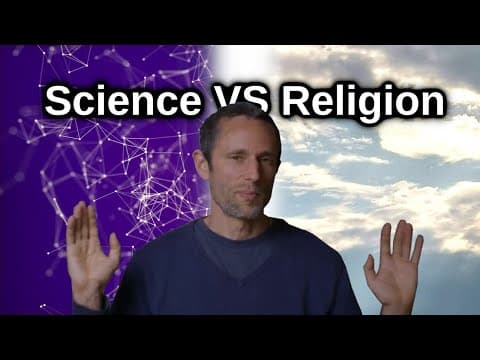
Science acknowledges the existence of a causal, force-based world, much like religion does. However, it denies the existence of a separate spiritual realm. Where religion posits two worlds—the mundane and the sacred—science asserts that only the mundane, material world exists.
Rather than being a radical break, science can be understood as the culmination of a long process that began with animism. This process involved progressively abstracting sacredness and spirit away from the material world until, in science, these concepts are eliminated entirely.
The relationship between science and religion regarding sacredness is complex and nuanced. Science did not emerge in opposition to religious thought but rather as an extension of a historical trend that began with animistic beliefs and evolved through monotheistic abstractions.
While religion traditionally separated the sacred from the material world, science removes the sacred altogether, leaving a universe governed solely by natural laws. Understanding this continuum helps bridge the perceived divide between science and religion and offers insight into how humanity's conception of sacredness has transformed over millennia.