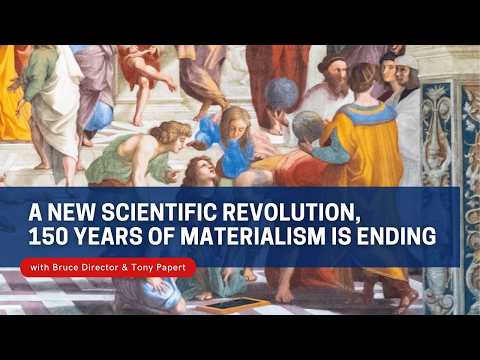
Science is experiencing a fundamental revolution, moving beyond 150 years of materialistic and physicalist paradigms. This shift recognizes the universe as fundamentally creative, integrating immaterial ideas with material reality. Influential scientists challenge prevailing frameworks, advocating new approaches inspired by Platonic philosophy and the LaRouche-Riemann method, promising breakthroughs in physics, biology, and economics.
Science today stands at the threshold of a profound revolution, challenging the materialistic and physicalist paradigms that have dominated for the past 150 years. This revolution is not merely scientific but is intertwined with a broader cultural and societal renaissance. It questions the foundational assumptions about the nature of the universe and humanity's relationship to it.
Bruce Director, a lifelong scholar in this field, in collaboration with Lyndon LaRouche, has been pivotal in developing concepts that advance science beyond physicalism. This new science recognizes the universe as fundamentally creative and, implicitly, acknowledges a creator of that universe.
The way people conceptualize science and the universe deeply influences societal thinking and vice versa. Prevailing scientific ideas, though often technical and specialized, filter into the general public's worldview, shaping culture and politics. Recognizing the flaws in these prevailing opinions is the first step toward a renaissance.
Recognition of Prevailing Errors: There is a growing awareness that current scientific and cultural opinions are inadequate and often incorrect. For example, economic doctrines like free trade and globalism are increasingly seen as flawed.
Acknowledgment of a Wrong Turn: Beyond new evidence, there is a realization that humanity took a fundamentally wrong path based on flawed assumptions and ideas, both in science and society.
This dual recognition fuels the conflict between established beliefs and emerging realities, catalyzing revolutionary change.
Despite unprecedented technological achievements—from horse-drawn carriages to space exploration and instantaneous communication—the scientific frameworks underpinning these advances fail to fully explain the processes involved. There is a discrepancy between what scientists believe they are doing and the actual creative processes driving innovation.
Human creativity, an immaterial and unique capacity, enables breakthroughs that cannot be accounted for by existing materialistic science. This creativity bridges immaterial ideas and tangible physical effects, transforming the universe.
Did rockets come into existence when the first rocket was launched or when the idea was conceived by inventors? Similarly, did human flight begin with the Wright brothers or with Leonardo da Vinci's designs? These questions illustrate the primacy of immaterial ideas in creating material realities.
In fields like physics, biology, and medicine, many scientists recognize that materialistic science cannot fully explain observed phenomena or harness nature's potential. Hundreds or thousands of scientists are searching for new frameworks but remain uncertain about the path forward.
Bruce Director contends that the LaRouche-Riemann method, developed by Lyndon LaRouche, offers a promising framework. This method is rooted in the concept that the universe is fundamentally creative, a principle that extends beyond human creativity to the cosmos itself.
If the universe is fundamentally creative, it implies the existence of a creator and an act of creation. This idea aligns with theological perspectives found in texts like the Book of Genesis and the First Epistle of John. Scientific evidence also supports that embracing the universe's creativity enhances human power to solve problems beyond the reach of materialistic science.
The LaRouche-Riemann method studies creativity in physical economy, emphasizing the inseparability of immaterial ideas and material effects. This approach reveals how creative ideas lead to permanent transformations in the physical universe, measurable through parameters like energy flux density and potential relative population density.
Several contemporary scientists exemplify the struggle to transcend materialistic science:
Dr. Donald Hoffman (Neuroscientist, University of San Diego): Hoffman challenges the assumption that consciousness arises solely from biochemical brain processes. He proposes consciousness as primary, with the material brain as secondary, and seeks a mathematical framework to support this view.
Dr. Michael Levin (Tufts University): Levin studies regenerative biology, such as salamander limb regrowth, and argues that bottom-up molecular explanations are insufficient. He advocates for a "platonic science" that considers immaterial ideas guiding material processes.
Dr. Dennis Noble (Physiologist, UK): Noble critiques the DNA-centric view of biology, emphasizing that the organism and cell regulate DNA, not vice versa.
Dr. Sara Imari Walker (Astrobiologist, Arizona State University): Walker explores the origins of life and proposes assembly theory, suggesting an underlying process beyond Darwinian evolution that shapes complexity and challenges conventional concepts of time.
Dr. Nima Arkani-Hamed (Physicist, Institute for Advanced Study, Princeton): Arkani-Hamed provocatively states "spacetime is dead," highlighting the incompatibility between general relativity and quantum mechanics and the need for a new fundamental physics framework.
These scientists acknowledge the limitations of current paradigms and the necessity for revolutionary ideas.
The division in scientific thought traces back 2,500 years to the philosophies of Aristotle and Plato:
Aristotle: Emphasized a separation between material and immaterial knowledge, with science focusing on material, empirical reality.
Plato: Advocated that material objects are reflections of immaterial ideas or forms, suggesting a deep connection between ideas and physical reality.
The dominant scientific view today aligns more with Aristotle's materialism, often dismissing immaterial ideas as abstract and unknowable.
During the Renaissance, Platonic ideas resurfaced, notably through Nicholas of Cusa, who revolutionized science by integrating immaterial ideas with empirical investigation. This tradition influenced great scientific and cultural progress, including the founding principles of the United States.
Bernhard Riemann, a 19th-century mathematician, extended the understanding of geometry beyond Euclidean assumptions. His habilitation paper questioned the axioms underlying geometry and introduced the concept of multiply extended magnitudes (manifolds), which can have various metric relations determined empirically.
Riemann's work, influenced by Carl Gauss and earlier thinkers like Gottfried Leibniz and Johannes Kepler, laid the groundwork for understanding physical space as a dynamic, measurable entity rather than a fixed backdrop.
The concept of the geodesic, or shortest path between two points on a surface, explains phenomena such as light reflection and refraction:
Reflection: Light reflects off a surface at an angle equal to its incidence angle, following the shortest path principle.
Refraction: Light bends when passing through different media, traveling the path of least time rather than shortest distance, as discovered by Willebrord Snellius.
These principles illustrate how metaphysical ideas about the universe's organization manifest in observable physical laws.
The principle of least action, a cornerstone of quantum mechanics and general relativity, is a metaphysical concept expressing the universe's tendency to organize action efficiently. Understanding and extending this principle through the LaRouche-Riemann method can unify physics, biology, and economics into a coherent framework.
Physical economy, as studied by LaRouche, involves the interaction of abiotic processes, physical laws, biological systems, and human cognition, all contributing to humanity's increasing power over nature.
The current crisis in basic science, marked by contradictions and limitations in materialistic frameworks, calls for embracing the universe's fundamental creativity. The LaRouche-Riemann method offers a promising path forward by integrating immaterial ideas with material reality, inspired by Platonic philosophy and advanced mathematical concepts.
Further exploration and discussion are needed to deepen understanding and apply these revolutionary ideas across scientific disciplines, ultimately fostering a new renaissance in science and society.
This article summarizes a rich and complex presentation on the ongoing scientific revolution, highlighting the need to rethink foundational assumptions and embrace creativity as the core principle of the universe.