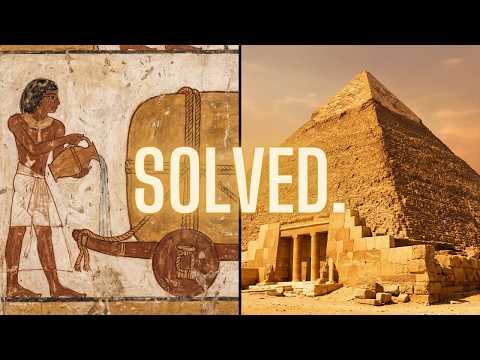
A 2014 physics experiment confirmed that ancient Egyptians reduced friction by wetting sand to move massive stones for pyramid construction. Archaeological evidence shows organized labor, advanced logistics, and innovative engineering methods, including ramps and precise leveling techniques. The Great Pyramid's construction was a feat of human ingenuity, patience, and planning, not magic or alien intervention.
In 1890, archaeologists uncovered a painting inside an Egyptian tomb depicting 172 men dragging a colossal statue on a sledge, with a small figure at the front pouring water onto the sand. For over a century, this detail was dismissed as symbolic or ritualistic. However, in 2014, a team of physicists in Amsterdam conducted an experiment that revealed this painting held the key to one of the oldest engineering mysteries on Earth: how the Egyptians moved massive stones to build the pyramids.
Standing at the base of the Great Pyramid, one is confronted with an immense structure covering 13 acres, rising 480 feet high, composed of approximately 2.3 million stone blocks. Most blocks are limestone from a nearby quarry, each weighing about 2.5 tons—comparable to a large SUV. The granite beams used in the king's chamber are even more massive, weighing up to 80 tons each, heavier than an M1 Abrams battle tank, and transported 500 meters from Aswan.
The construction timeline was roughly 20 years, requiring the placement of a block every 2 to 3 minutes continuously. This feat necessitated dozens of teams working simultaneously, a human machine operating without pause.
Dragging a two-ton block on a wooden sledge across dry sand is extremely difficult. The front edge of the sledge digs into the sand, creating a wave of sand that increases friction and stops the sledge. The 2014 physics team at the University of Amsterdam tested this by dragging a weighted sledge across dry sand, finding the force required was roughly double what it would be on a firm surface.
This friction would have made the project impossible unless the Egyptians had a method to reduce it.
The painting from 1890, once thought to be symbolic, actually depicted a practical technique. The small figure pouring water onto the sand was not performing a ritual but was demonstrating a method to reduce friction.
The Amsterdam team built a scaled-down replica sledge and dragged it across trays of desert sand. When the sand was dry, the sledge buried itself, requiring enormous force to pull. However, when they added a small amount of water—between 2 to 5% moisture content—the pulling force dropped by half.
High-speed cameras revealed that at this moisture level, water forms tiny capillary bridges between sand grains, locking them into stiff plates. This creates a temporary firm surface that rebuilds with each step, allowing the sledge to ride on top rather than plow through loose sand. Too little water had no effect, and too much turned the sand to mud, causing the sledge to sink.
This narrow moisture range could be maintained by a single worker walking ahead of the hauling team, sprinkling water from a jar.
The Great Pyramid sits on a flat limestone plateau, with the main quarry less than a third of a mile away. Archaeologists have found remains of prepared causeways—graded, compacted paths wide enough for multiple sledge teams.
Workers stationed at intervals along these causeways kept the sand in the critical moisture range, wet enough to firm the sand but dry enough to avoid mud. Water was abundant during the annual Nile flood, which reached canal systems and catchment basins near the construction site. Channels carved into the plateau directed floodwater to where it was needed.
This created a self-renewing highway, maintained by simple technology—clay jars and human hands—allowing multiple sledge teams to move hundreds of blocks per day.
Besides reducing friction, wetting the sand suppressed dust, which was critical for thousands of workers breathing desert air for months. It also stabilized the path surface, reducing injuries, and allowed supply sledges carrying tools and food to move faster alongside stone haulers, improving the entire logistics chain.
Excavations of the worker's village near the pyramid revealed it was not a slave camp but a well-organized city with industrial-scale bakeries, breweries producing nutritious beer, copper smithies, fish processing facilities, and grain storage.
Animal bones indicate workers consumed about 4,000 calories a day, a diet better than most in the ancient world. The workforce was divided into large groups called files, each subdivided into teams of about 200 men with their own identities and competitive spirit.
Historical records suggest a peak workforce of 20,000 to 25,000 during the flood season, supplemented by a smaller year-round crew of skilled masons and engineers. The project management was sophisticated, with shifts, rotations, supply ledgers, and ration lists, all coordinated via the Nile river during flood season.
The exact ramp system used to raise stones remains debated:
Single Straight Ramp: Would need to be nearly a mile long at a 10% gradient, containing more material than the pyramid itself, with no archaeological evidence found.
Partial Straight Ramp: A ramp reaching one-third of the pyramid's height could deliver most blocks, then be dismantled.
Internal Spiral Ramp: A compelling but unproven theory suggesting a spiral ramp inside the pyramid.
Other theories include external wraparound ramps, lever-based systems, or combinations thereof.
Physical evidence such as post holes in the Grand Gallery suggests wooden beams were used as anchor points or braking systems for hauling heavy loads upward. These beams could be repositioned as work progressed, providing rest points.
The pyramid's base is level within 2 cm across 230 meters, a deviation of less than 0.01%. This precision would challenge modern survey crews using optical or GPS equipment, especially considering the lack of metal straightedges or optical instruments in 2500 BCE.
The leading theory is that the Egyptians flooded foundation trenches with water and used the water line as a level, cutting reference posts to the same height above the water surface. Draining the trenches left a perfectly level datum across the site.
The outer casing stones were joined so tightly that gaps measured roughly half a millimeter, thinner than a credit card. Some joints are so tight that a razor blade cannot fit between blocks.
Above the king's chamber are five relieving chambers separated by massive granite beams weighing between 40 and 80 tons. These beams were quarried in Aswan, transported by barge, and raised over 150 feet into the pyramid's core.
Jean-Pierre Houdin's theory proposes these beams were hauled up the pyramid's outer face on a temporary ramp, then slid horizontally through a gap left in the masonry at the chamber level. The gap was sealed afterward, making the repair invisible from outside.
In 2017, the Scan Pyramids project detected a large void above the Grand Gallery using muon tomography, confirming the pyramid's internal structure is more complex than a simple stack of blocks. The void's exact purpose remains debated.
King Khufu reigned for about 23 years, and the pyramid had to be finished within his lifetime. Radiocarbon dating of organic material in the pyramid's mortar aligns with Khufu's reign (circa 2580 to 2560 BCE).
Animal bone counts from the workers' village show peak slaughter rates during flood months, coinciding with labor availability and river transport. Copper tool wear rates, sledge cycle estimates, and food intake data all support a 20-year construction schedule.
Despite advances, some questions remain:
However, the convergence of physical evidence, experimental confirmation, archaeological context, and mathematical plausibility tells a coherent story.
After the pyramid's completion, causeways were dismantled, basins silted over, and the harbor retreated. Yet, the knowledge persisted and evolved.
Middle Kingdom tombs show smaller statues hauled similarly, always with a water bearer at the front. By the New Kingdom, bronze tools and animal-powered capstans supplemented human hauling. The wet sand technique became standard practice and eventually ordinary.
The 2014 experiment did not rewrite physics but changed our understanding of human capability. For centuries, myths suggested slaves or aliens built the pyramids, assuming ordinary humans could not achieve such feats.
The truth is simpler and more profound: patient, organized human labor using simple technology and steady effort over 20 years built the Great Pyramid.
Today, road crews still spray water before compacting gravel—the principle remains unchanged after 4,500 years.
The Great Pyramid is not an enigma but a mirror reflecting human patience, planning, logistics, and cooperation. It stands as a testament that extraordinary achievements come not from miracles but from people working together with determination and ingenuity.
From above, the Great Pyramid still casts its shadow across the plateau, reminding us that we didn't need magic—we needed each other.