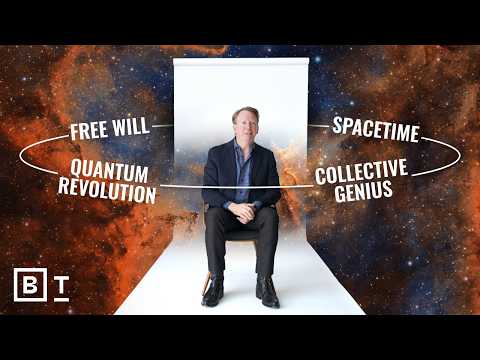
In this interview, physicist Sean Carroll explores the paradox of physics being both simple and complex. He discusses the evolution of classical mechanics, the implications of quantum mechanics, and the challenges of understanding the universe's fundamental laws. Carroll emphasizes the importance of simplification in physics, the role of determinism, and the ongoing quest for a unified theory of everything, while also addressing the limitations of current scientific understanding.
Physics is often perceived as a challenging subject, filled with complex equations and abstract concepts. However, physicist Sean Carroll argues that the difficulty of physics arises from its inherent simplicity. In this interview, Carroll delves into the nature of physics, its historical evolution, and the philosophical implications of its principles.
Carroll begins by stating that physics is hard because it is easy. He explains that while students struggle with physics due to unfamiliar concepts and equations, the underlying principles are often quite simple. Physicists have developed techniques to distill the complexities of the universe into manageable models. For instance, idealized scenarios, such as frictionless surfaces or perfectly swinging pendulums, allow physicists to simplify real-world phenomena for analysis.
To illustrate this point, Carroll shares a humorous anecdote about a dairy farmer seeking advice from a physicist to increase milk production. The physicist suggests starting with a spherical cow, highlighting the tendency of physicists to simplify problems to make calculations easier. While this approach may not work in agriculture, it is effective in physics, where idealized models can lead to profound insights about the universe.
The conversation shifts to the historical context of physics, particularly the contributions of Isaac Newton. Carroll describes the transition from Aristotle's views, which suggested that objects have natural places and motions, to Newton's revolutionary ideas. Newton proposed that an object in motion remains in motion unless acted upon by a force, fundamentally changing our understanding of motion and mechanics.
Carroll introduces the concept of Laplace's demon, a thought experiment that illustrates determinism in classical mechanics. If one could know the position and velocity of every particle in the universe, they could predict the future and reconstruct the past. This idea led to the notion of a clockwork universe, where everything operates according to deterministic laws. However, Carroll notes that this perspective raises questions about human agency and free will.
As the discussion progresses, Carroll highlights the limitations of classical mechanics and the emergence of quantum mechanics. He explains that while classical mechanics provides a deterministic framework, quantum mechanics introduces uncertainty and probabilistic outcomes. The famous twin paradox exemplifies how time can be experienced differently based on an individual's trajectory through spacetime.
Carroll addresses the measurement problem in quantum mechanics, where the act of measurement influences the state of a quantum system. This leads to philosophical questions about the nature of reality and the role of consciousness in the measurement process. While some theorists suggest that consciousness plays a crucial role, Carroll remains skeptical, emphasizing that consciousness arises from complex interactions governed by physical laws.
The conversation then shifts to the standard model of particle physics, which describes the fundamental particles and forces in the universe. Carroll explains how the discovery of particles like quarks and the Higgs boson has advanced our understanding of matter. However, he acknowledges that the standard model does not account for phenomena such as dark matter and gravity at a quantum level.
Carroll introduces the concept of emergence, where complex systems exhibit properties that cannot be easily predicted from their individual components. He emphasizes that while physicists have a solid understanding of the core theory of physics, applying this knowledge to fields like biology or psychology is challenging due to the complexity of these systems.
As the interview concludes, Carroll reflects on the future of physics and the ongoing quest for a unified theory of everything. He expresses optimism about the potential of new technologies, such as quantum computers, to aid in scientific discovery. However, he remains cautious about the limitations of computational tools in generating new conceptual breakthroughs.
Sean Carroll's insights into the nature of physics reveal a discipline that is both simple and impossibly complex. As physicists continue to explore the universe's fundamental laws, the interplay between simplicity and complexity will remain a central theme in the ongoing pursuit of knowledge. Carroll's reflections serve as a reminder of the importance of curiosity, collaboration, and the willingness to question established ideas in the quest for understanding the cosmos.