In this update, Scott Manley discusses recent space missions, including Falcon 9 launches, China's advancements, and the FAA's new ban on daytime rocket launches. The implications for commercial space travel and NASA's leadership changes are also explored.
Hello, it's Scott Manley here. It is November 6th, and I am finally back from the east coast. After a busy couple of weeks, it's time for some deep space updates.
In the last two weeks, we have seen seven Starlink launches: four from Vandenberg and three from Florida. These launches continue to expand the Starlink satellite constellation, which aims to provide global internet coverage.
On October 24th, a Falcon 9 rocket launched Spain's NG2 to a geostationary transfer orbit from Slick 40 in Florida. This encrypted communication satellite for the Spanish armed forces replaces the existing SpainSat satellite. Notably, this launch marked the final flight of booster 1076, which had completed 22 missions before burning up over the Atlantic.
On October 26th, Japan's H3 rocket launched the HTV X1, a new version of the HTV cargo ferry used to send supplies to the International Space Station (ISS). This test launch was intentionally underloaded to ensure the full autonomous flight termination system was operational. The HTV X1 will remain at the ISS for several months, carrying various cargo and conducting experiments, including a sake fermentation project.
Also on October 26th, China launched a Long March 3B EE rocket from the Chi-Chang Launch Complex 3, deploying the Galen 14 satellite. This high-resolution Earth observation satellite is part of China's civilian observation system, used for land observation and urban planning.
On October 31st, a Long March 2/G rocket launched Shenha 21 into low Earth orbit, successfully docking with the Chinese space station. The crew aboard cooked chicken wings and steak in orbit, showcasing the culinary possibilities in space. However, the return of Shenha 20 has been delayed due to space debris damage.
On November 2nd, the Falcon 9 Bandwagon mission launched a small satellite ride-share mission to a 45-degree inclination orbit. This mission included various payloads, such as the first data center in orbit demo and technology tests for Haven's space station.
On November 2nd, India launched the GAT 7R satellite into geostationary transfer orbit using their LVM launch vehicle. This satellite, weighing approximately 4.4 tons, demonstrated the capability of relighting the rocket's upper stage engine, which is crucial for future multi-payload missions.
On November 3rd, the Long March 7A launched Yagan 46 into medium Earth orbit, while on November 4th, the Arian 6 rocket carried Sentinel 1D, a sun-synchronous Earth observation radar satellite, into orbit.
On November 5th, Rocket Lab's Electron rocket launched satellites for IQPS, marking the fifth flight of an 11-flight contract.
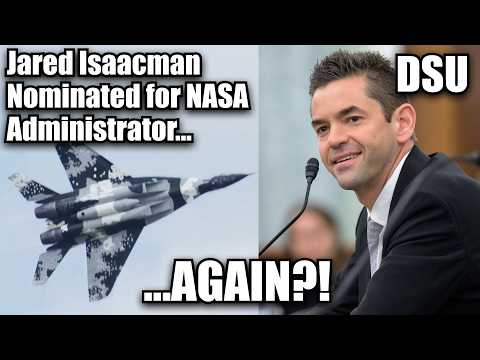
One of the most significant pieces of news is the renomination of Jared Eiserman to run NASA. His previous nomination was notable for being the fastest in history, and now he faces the challenge of navigating the political landscape once again. Eiserman's project Athena outlines plans to transition NASA's science into a service model, emphasizing collaboration with commercial providers.
Project Athena includes discussions on nuclear electric propulsion strategies, which could play a vital role in future space missions. This technology has specific niches where it could be highly effective, particularly in deep space exploration.
In light of recent events, the FAA has announced a ban on all commercial space flights during daylight hours, restricting launches to between 10 p.m. and 6 a.m. This decision is particularly impactful for SpaceX, which conducts a significant number of commercial launches. The FAA's move comes amidst a government shutdown that has affected air traffic control operations, leading to reduced flight capacity at major airports.
As we look ahead, the implications of these developments will shape the future of space exploration and commercial space travel. The recent launches demonstrate the ongoing advancements in space technology, while the FAA's regulations and NASA's leadership changes highlight the complexities of managing space operations in a rapidly evolving environment.
Stay tuned for more updates as we continue to explore the final frontier. Fly safe!