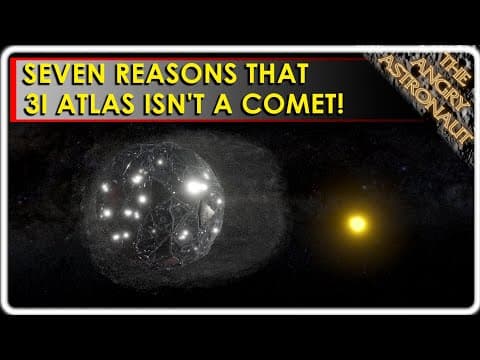
This article explores the peculiar characteristics of 3I Atlas, an object often mistaken for a comet. It presents seven compelling reasons, including its unusual light polarization, lack of a traditional tail, and atypical composition, suggesting that 3I Atlas may not fit the comet classification at all.
The fascination with celestial objects often leads to comparisons that may not hold up under scrutiny. In the case of 3I Atlas, many in the mainstream media and scientific community have likened it to a comet. However, a closer examination reveals that this object exhibits several characteristics that challenge its classification as a comet. Here are seven reasons why 3I Atlas might not be a comet at all.
A recent study titled "Extreme Negative Polarization of New Interstellar Comet" highlights that the light emitted by 3I Atlas does not resemble that of any known comet. Light is a wave consisting of oscillating electric and magnetic fields, and the polarization of this light can indicate the object's shape and surface properties.
3I Atlas displays an extreme negative polarization that is unprecedented among comets and asteroids. This behavior suggests that 3I Atlas is fundamentally different from any interstellar object previously observed, indicating that it may not be a comet at all.
Comets are typically characterized by their tails, which form as they approach the sun and release gas and dust. However, 3I Atlas does not exhibit a conventional tail. Instead, it has an anti-tail, which is a glow extending in the opposite direction of the sun. This anti-tail is significantly larger than any previously recorded, raising questions about its nature and behavior.
3I Atlas was observed to be active even when it was nearly 900 million kilometers away from the sun, a distance at which traditional comets would not exhibit any outgassing. This early activity challenges our understanding of comet behavior, as it suggests that 3I Atlas may not be following the typical patterns associated with comets.
The composition of 3I Atlas further complicates its classification. Traditional comets are expected to contain significant amounts of water, but spectroscopic analysis has shown that 3I Atlas emits primarily carbon dioxide, with only trace amounts of water. This unusual ratio has never been observed in any comet, suggesting that 3I Atlas may not fit the comet mold.
3I Atlas has been found to contain nickel and cyanide, with the presence of nickel being particularly striking. Nickel is typically found in nickel-iron asteroids, but the absence of iron in 3I Atlas is unprecedented among comets. This unique composition raises further questions about the object's origins and classification.
The size of 3I Atlas is another factor that sets it apart from traditional comets. Estimates suggest that its nucleus could be as large as 46 kilometers in diameter, making it significantly larger than any known interstellar comet. The mass loss rate from 3I Atlas is also inconsistent with its size, as it is not producing enough activity to be classified as a comet of its scale.
3I Atlas is approaching the inner solar system on a trajectory that closely aligns with the plane of the ecliptic, which is statistically improbable. Its path allows it to pass near multiple planets, including Venus, Mars, and Jupiter, raising the possibility of it being an artificial construct. The odds of such a trajectory occurring by chance are astronomically low, further complicating its classification.
Given these seven compelling reasons, it becomes increasingly clear that 3I Atlas may not be a comet in the traditional sense. While it might share some superficial similarities with comets, its unique characteristics suggest that it could belong to a category of its own. As we continue to study this enigmatic object, it is crucial to approach its classification with caution and an open mind, recognizing that our understanding of celestial phenomena is still evolving.