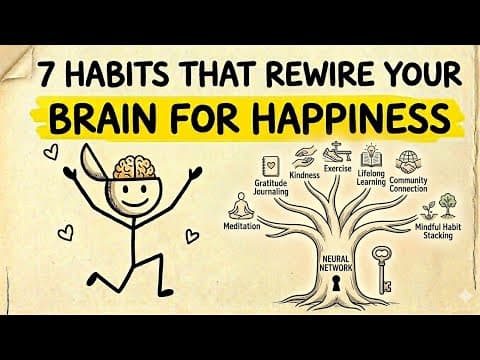
Happiness is often influenced more by our daily habits than by external circumstances. This article explores seven practical habits—resetting your facial expression, naming your emotions, taking small actions, interrupting negative thought loops, savoring good moments, moving your body, and engaging in fun activities—that can rewire your brain to foster lasting happiness and emotional well-being.
What if the reason you don't feel happy isn't in your life circumstances, but in your daily habits? Instead of waiting for big changes like success or clarity, you can influence your emotional state by the small, repeated signals your brain receives every day. Your brain responds to these subtle cues, which you control.
Here are seven simple habits that can shift how you feel almost instantly—not just temporarily, but in a way that gradually becomes your default state.
Your brain constantly scans your body to decide how you feel, and your face is one of the fastest signals it trusts. Instead of waiting to feel good, change the signal first:
Hold this relaxed expression for a few seconds. This small shift signals your brain that you are safe. When your brain feels safe, it lowers stress and shifts your emotional state automatically. You are not forcing happiness; you are signaling safety, which creates calm.
Emotions often feel overwhelming because they are unclear and run in the background unnoticed. When you say aloud or to yourself, "I feel stressed," "I feel anxious," or "I feel low," something changes. You create space between yourself and the emotion, becoming an observer rather than being inside it. This awareness reduces the intensity of the emotion.
You don't need to fix everything instantly or have all the answers right now. Awareness and clarity weaken emotional chaos.
Many people wait to feel motivated before acting, but motivation often comes after action, not before. Take one small action right now, such as:
Even actions that feel almost pointless create progress, which triggers dopamine release. Dopamine shifts your mood and builds momentum. Starting is often the hardest part, but once you begin, your brain helps you move forward.
Your brain is wired to repeat what you focus on. When you keep thinking about problems, it strengthens that loop, making it harder to stop. Break the loop early by:
You are not avoiding the problem but stopping the pattern. Once the pattern stops, you regain control.
Good moments happen every day, often small and quiet, but your brain moves past them too quickly without storing or building on them. Slow down when something feels even slightly good:
This trains your brain to recognize what is going right, gradually changing what your mind naturally looks for.
Your emotional state is not just in your mind but also in your body. When your body is still, your thoughts tend to stay stuck. Movement signals change, and your brain responds immediately. Try:
Even small movements can break emotional heaviness and shift your state.
As people grow older, they often remove play from their lives, making everything serious and purposeful, which can make life feel heavy. Your brain needs moments of play without pressure. Spending even a few minutes doing something you enjoy just for the feeling of it can reset your entire state.
In these moments, you are not trying to get somewhere; you are simply present. This presence brings real lightness.
Imagine feeling off. Instead of waiting for it to pass, you act:
In just a few minutes, your state begins to shift—not because your life changed, but because you changed how your brain responds. This is the real power.
Happiness is not something you find someday; it is something you practice daily. These habits are simple but only work if you use them.
Start by picking just one habit and use it today. The moment you act, you start rewiring your brain. Change happens when you apply these habits again and again.
If you know someone who feels stuck in their own mind, share these habits with them. Sometimes, one small shift is all it takes to change everything.