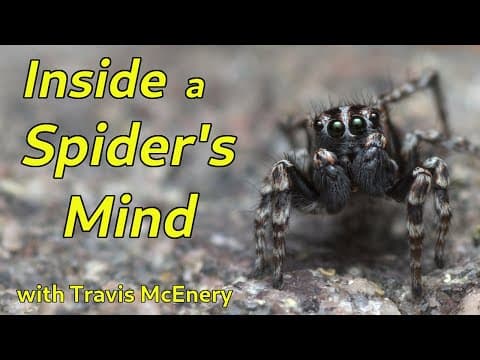
Spiders, especially jumping spiders, exhibit remarkable cognitive abilities despite their tiny brains. Research shows they use efficient sensory processing, memory, learning, and spatial navigation to solve survival problems. Their vision and other senses enable complex behaviors like prey discrimination, detouring, and possibly dreaming, challenging the notion that small brains limit intelligence.
Have you ever wondered what it would be like to be a spider or questioned how intelligent they really are? Determining spider intelligence is not straightforward, but by studying their cognition—the adaptive processing of information from sensory input to decision-making and behavior—we can gain insights into their mental capabilities.
Cognition broadly refers to how an organism gathers information through its senses, makes decisions, and performs appropriate actions. For a long time, spiders were thought to be simple automatons, little robots without much processing power. However, this view has changed, especially with studies on jumping spiders, which have revealed surprising levels of cognitive function.
Experts like Dr. Himemena Nelson and Dr. Masimo Diagro emphasize that cognition is a complex and debated topic. It involves more than reflexes; it includes how sensory information is elaborated and transformed into behavior. Even small animals like spiders process sensory data and make decisions, indicating some level of cognition.
Brain size has historically been linked to intelligence, but this relationship is complicated. While brain-to-body size ratio (encephalization quotient) can correlate with cognitive abilities in some animals, this does not always hold true for invertebrates like spiders. Physical constraints limit the size of arthropods' brains, so evolution favors efficiency—creating more clever neural circuits with fewer neurons.
This concept, known as the economy of design, means spiders optimize their sensory systems and neural processing to solve complex problems despite their tiny brains.
Jumping spiders demonstrate remarkable sensory efficiency. For example, their lateral eyes detect motion and send direct signals to their legs to turn a precise amount, bypassing complex brain feedback loops. This reduces processing load and speeds up responses.
Dr. Nelson studied a species called Varicora, nicknamed "mosquito terminators," which specialize in hunting female Anopheles mosquitoes—the malaria vectors. These tiny spiders (about 1.5 mm long) can discriminate subtle visual cues such as the feathery texture of mosquito antennae and the posture of resting mosquitoes to identify their preferred prey.
Using 3D animations and abstract line drawings, researchers found that these spiders use visual shortcuts, focusing on key features like relative angles and shapes rather than processing the entire prey image. This selective attention allows them to make fast, accurate hunting decisions.
Jumping spiders can distinguish biological motion—movement patterns characteristic of living creatures—from random motion. This ability is similar to how humans perceive life in moving dot patterns representing joint movements. Different sets of spider eyes specialize in detecting motion, discriminating biological motion, and detailed target identification, effectively dividing labor to enhance cognitive efficiency.
While jumping spiders rely heavily on vision, most spiders have poor eyesight but possess other sophisticated sensory systems:
Research on how these senses contribute to cognition is limited but promising. For example, orb-weaving spiders use their webs as hyperacute acoustic sensors, functioning like giant eardrums that can be tuned to detect prey wing beats and filter out irrelevant noise like wind.
Spiders exhibit surprising memory and learning capabilities:
Experiments have shown that jumping spiders can learn to associate colors with food rewards, although they learn biologically relevant tasks more readily than irrelevant ones.
Jumping spiders display advanced spatial cognition by planning detours to approach prey from safe angles, especially when hunting dangerous spiders. Vision plays a crucial role here, allowing them to assess risk and plan routes from a distance.
Other spiders, like wolf and huntsman spiders, use path integration to navigate, keeping track of direction and distance traveled relative to their home base without forming a cognitive map. Some desert spiders memorize horizon snapshots to navigate at night, traveling impressive distances and returning home accurately.
Researchers believe that while jumping spiders' advanced vision contributes to their cognitive abilities, other spiders may be equally intelligent in ways we do not yet recognize. Our bias toward visual cognition may limit our understanding of other sensory-based intelligence.
In 2022, researchers observed jumping spiders exhibiting rapid eye movements during rest, similar to REM sleep in humans, which is associated with dreaming. While this does not confirm that spiders dream, it suggests their internal experiences might be more complex than previously thought.
Scientists caution against anthropomorphizing spiders too much, as it risks misinterpreting facts. However, dismissing similarities between spider cognition and human cognition can also hinder understanding. A balanced approach is essential to uncover the true nature of spider minds.
Spiders, with over 50,000 species worldwide, exhibit a rich diversity of cognitive abilities. From efficient sensory processing and memory to learning and complex navigation, their tiny brains perform mighty tasks. As research advances, we continue to uncover the fascinating ways spiders perceive and interact with their world, challenging our assumptions about intelligence and cognition in small creatures.
The study of spider cognition not only enriches our understanding of these remarkable animals but also offers insights into the evolution of intelligence and sensory processing across species.
Thank you for exploring the intriguing world of spider cognition. The more we learn, the more we appreciate the complexity hidden within these tiny brains.