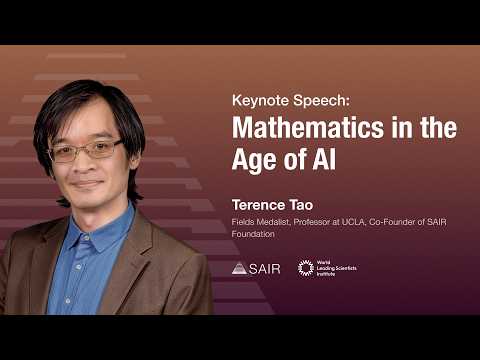
Terence Tao discusses the conservative nature of mathematics and how AI is beginning to change mathematical research. He highlights the challenges of collaboration in math, the role of formal verification, and shares examples of large-scale collaborative projects and AI-assisted problem solving. Tao emphasizes AI's potential to expand mathematical research rather than replace human creativity.
Mathematics, a field known for its conservatism and continuity, is beginning to experience significant changes due to the advent of artificial intelligence (AI). Terence Tao, a renowned mathematician, shares his perspective on how AI is transforming mathematical research and collaboration, and how these changes might impact other sciences.
Mathematics is one of the most conservative academic disciplines. Tao illustrates this by showing a 200-year-old textbook by Koshi, which introduces concepts like the Cauchy integral formula. Despite being centuries old and written in French, the textbook's content and style are strikingly similar to modern graduate-level mathematics textbooks. This continuity is a strength, as mathematicians routinely use results that are thousands of years old, such as the Pythagorean theorem.
However, this conservatism also means that mathematics has been slow to embrace new trends and technologies. For example, mathematicians still predominantly use blackboards and chalk, unlike other disciplines that have moved on to digital presentations and whiteboards. Tao mentions a coffee table book by photographer Jessica Wyn, who captured images of mathematicians' chalkboards, highlighting this unique tradition.
Another distinctive feature of mathematics is the relatively low level of collaboration compared to other sciences. While the average number of authors per paper in mathematics has increased from about 1.5 to 2.5 over the years, other sciences have seen explosive growth in collaborative research projects.
This lag is not due to mathematicians being antisocial but stems from systemic issues:
Despite these challenges, new technologies, including AI, are beginning to enable large-scale collaborative projects in mathematics.
Tao describes a shift from traditional case-study approaches, where mathematicians focus on one problem at a time, to broader surveys that study thousands or millions of problems simultaneously. This expansion allows for the collection of interesting statistics and insights across large populations of problems.
Citizen mathematics is emerging, allowing participation beyond professional mathematicians, including computer scientists, students, and even high school students. AI and machine learning are starting to be used effectively, although many incorrect approaches have been tried and discarded.
A crucial enabler of these new workflows is formal verification — a computer language and system that can automatically check the correctness of mathematical arguments. This technology filters out errors and allows for precise, atomic-level discussions about proofs, even among contributors who do not know each other.
One of Tao's projects, launched at UCLA, exemplifies these new collaborative methods. The Equational Theories Project involved 50 collaborators, many of whom Tao had never met, including non-professional mathematicians.
The project generated 22 million algebraic problems, such as whether the commutative law implies the associative law for a given operation. While a graduate student might solve one such problem in an hour, solving millions was impossible without new methods.
The team used a combination of:
This modular approach allowed participants to specialize in different tasks, such as writing human-readable proofs or translating them into formal proofs. The project was decentralized, with spontaneous independent contributions that collectively moved the project forward.
Formal verification was key to breaking the trust barrier, enabling acceptance of anonymous or untrusted contributions by ensuring all proofs passed rigorous automated checks.
The project was completed in three months, with every problem either proved or disproved.
Tao also discusses ongoing work with Google DeepMind involving large language models (LLMs) like AlphaEvolve. These models can solve certain classes of math problems and improve bounds on optimization problems, such as packing problems involving hexagons.
However, LLMs currently make frequent mistakes, even on simple arithmetic, limiting their reliability. Combining LLM outputs with formal verification and iterative feedback loops, where errors are sent back to the model for correction, shows promise.
While Tao cannot yet disclose all details of this collaboration, preliminary results indicate progress in both finite and infinite-dimensional optimization problems.
AI tools are already transforming mathematics by assisting with secondary tasks such as writing code and performing literature reviews. They also serve as universal translators, helping mathematicians communicate with the general public and other scientists.
For more advanced applications, rigorous verification remains essential to ensure trustworthiness. AI is expected to be most effective when integrated into broader collaborative efforts, filling gaps and expanding the scope of mathematical research.
Tao envisions AI not as a competitor to human mathematicians but as a means to enlarge the scope of mathematical problems tackled. AI can handle large volumes of medium-difficulty problems, proving low-hanging fruit and escalating challenging cases to human experts.
This approach can create more economically feasible objectives and expand the "pie" of mathematical work rather than competing for existing tasks.
The age of AI is ushering in transformative changes in mathematics, a field traditionally resistant to rapid change. Through formal verification, collaborative platforms, and AI-assisted problem solving, mathematicians are beginning to tackle problems at unprecedented scales and complexity.
While challenges remain, especially regarding AI reliability and integration, the future promises a richer, more collaborative, and more productive mathematical landscape.
Terence Tao's insights highlight the exciting potential of AI to complement human creativity and expand the frontiers of mathematical knowledge.