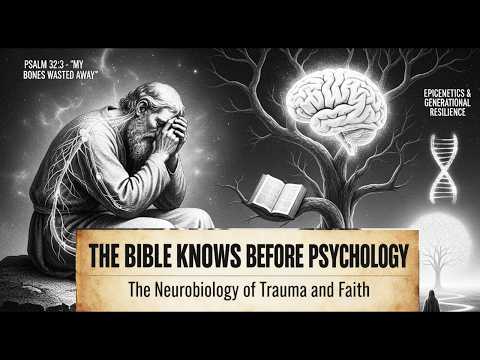
This article explores how the Bible, written long before modern psychology, offers profound insights into trauma and healing that align with contemporary neurobiology and trauma therapy. It examines biblical figures like Elijah and David, the role of lament, co-regulation, forgiveness, and neuroplasticity, showing that healing is a holistic process involving body, mind, and community, with God as the ultimate source of comfort and restoration.
In today's world, terms like trauma, nervous system, and PTSD are commonly discussed, with modern psychology explaining how our brains respond to pain. Simultaneously, faith offers hope. However, these two realms often seem disconnected. Some view psychology as secular, while others see the Bible as outdated and insufficient for addressing complex psychological wounds.
This article proposes a bold thesis: the Bible understood human trauma long before psychology named it. When we read scripture through the lens of modern neurobiology, we find not contradiction but a blueprint for healing. God, the architect of our nervous system, laid out paths for healing thousands of years ago—paths that modern trauma therapy is only beginning to rediscover.
One of the most significant breakthroughs in trauma research is recognizing trauma as a physical reality stored in the present, not just a story about the past. Dr. Bessel van der Kolk famously said, "The body keeps the score." Overwhelming stress captures energy in the nervous system, causing muscles to stay braced, heart rate variability to change, and even digestive shutdown.
The Bible, long before MRIs or cortisol tests, described psychosomatic illness with haunting precision. For example, in Psalm 32, King David writes, "When I kept silent, my bones wasted away through my groaning all day long." This is not mere sadness but physiological decay. The Hebrew word for bones refers to the body's very structure and essence, indicating that suppressed trauma and guilt can physically break down the body.
Modern psychoneuroimmunology confirms that suppressed trauma leads to chronic inflammation and weakened immunity. The Bible uses the word "heart" (lev in Hebrew) to describe the entire person, including the body. Proverbs 17:22 states, "A cheerful heart is good medicine, but a crushed spirit dries up the bones." This is a neurobiological observation: a traumatized, shut-down nervous system affects bone marrow and the body's healing ability.
The prophet Elijah's story in 1 Kings 19 offers a powerful case study in trauma. After a great spiritual victory, Elijah receives a death threat from Queen Jezebel and flees into the wilderness, sitting under a tree and praying to die. Psychologically, Elijah is in dorsal vagal shutdown—a freeze state where he can neither fight nor flee and is completely depleted.
God's response is biological first: He allows Elijah to sleep and provides food, addressing Elijah's nervous system through rest and nourishment, meeting basic survival needs. Only after physical stabilization does God lead Elijah to a cave for a deeper encounter. Notably, God does not appear in dramatic natural events like wind, earthquake, or fire, which could further startle Elijah's nervous system. Instead, God meets him in a gentle whisper, a low-frequency soothing presence that downregulates the amygdala.
This teaches a vital lesson: when the body is in alarm, spiritual truths cannot be processed until the nervous system feels safe.
Many modern faith communities struggle with toxic positivity—the pressure to always be joyful and victorious. However, the Bible contains an entire book of Lamentations and many psalms of lament, which are psychologically vital.
Modern trauma therapies like EMDR and somatic experiencing emphasize voicing pain to release it from the body. Suppressed trauma remains stuck. The biblical practice of lament acts as a divine release valve, giving permission to protest, scream, and bring raw questions to God.
Jesus in the Garden of Gethsemane exemplifies this. He sweats blood (hematidrosis) under extreme stress and says, "My soul is overwhelmed with sorrow to the point of death." He does not spiritualize his pain away but names it. Psychology teaches, "If you can name it, you can tame it." Naming overwhelming sensations moves processing from emotional centers to the prefrontal cortex, where integration occurs.
The Bible understood that peace comes not by avoiding the valley of the shadow of death but by going through it with honest lament.
A major discovery in psychology is co-regulation: a traumatized nervous system often cannot calm itself and needs the presence of another safe person to reset.
This biological foundation underlies the body of Christ. Galatians 6:2 says, "Bear one another's burdens," and Romans 12:15 says, "Weep with those who weep." Sitting with someone who suffers, sharing steady breath and empathetic gaze, provides the safety needed to move out of survival mode.
Psalm 34:18 describes God as near to the brokenhearted, the ultimate co-regulator. God is not a distant judge but a present attachment figure. Eye contact and facial expression—the face-to-heart connection—are key to healing. When the Bible speaks of God's face shining upon us, it describes the source of our deepest emotional security.
Epigenetics, a cutting-edge field, studies how trauma passes down generations through DNA, not just behavior. Children of Holocaust survivors or famine victims carry biological signatures of trauma in their stress hormones.
The Bible anticipated this in Exodus 34:7, stating that the iniquity of the fathers is visited upon the children to the third and fourth generation. This was once seen as a curse but is now understood as a description of trauma cycles.
Generational trauma occurs when unprocessed trauma in a parent creates emotional wounds in children. The Bible identifies this cycle to name and break it.
Yet, the Bible also offers neuroplastic hope. While trauma affects generations, God's steadfast love extends to a thousand generations. Modern psychology calls this generational resilience. Safety and love leave stronger biological imprints than trauma.
Healing is not just individual but about breaking family lineages of hypervigilance and replacing them with shalom (peace).
Forgiveness is often misused as a weapon to silence victims. However, the Bible presents forgiveness as a sophisticated psychological tool for survivors.
Studies show unforgiveness keeps the body in chronic stress, fight or flight mode. Holding onto the debt of someone who hurt us keeps the brain tethered to the perpetrator, trapping us in the past.
The biblical command to forgive is a command to release the nervous system. It does not condone the wrongdoing but says, "I will no longer let your sin live in my body." By entrusting justice to God (Romans 12:19), the survivor's brain can move out of defense.
Psychology calls this decisionary forgiveness, allowing the prefrontal cortex to regain control from the amygdala. The Bible knew that seeking personal vengeance keeps the nervous system on fire, but trusting a just God allows the body to experience safety.
Modern psychology celebrates neuroplasticity—the brain's ability to change and rewire itself. We are not stuck with the brain we have.
The Apostle Paul describes this in Romans 12:2: "Do not be conformed to this world, but be transformed by the renewal of your mind." The Greek word for transformed, metamorpho, is the same used for a caterpillar becoming a butterfly.
Trauma creates dark highways in the brain, but renewing the mind builds new healthy neural pathways. Meditating on what is true, noble, and right (Philippians 4:8) fires and wires new connections that compete with old trauma pathways.
Jesus on the cross experienced every state of trauma: flight (disciples deserting), fight (spiritual battle), and freeze/collapse ("My God, why have you forsaken me?").
He entered the depths of human trauma to meet us where we are, whether screaming in pain or silent in a cave. We are not broken beyond repair but masterpieces being restored by the one who wrote the manual on the soul.
The Bible is not a dry rule book but a deeply human document speaking the language of our pain. Elijah was not a failure but a man at his neurological limit whom God met with sleep and food. David was not merely poetic but described the physical toll of suppressed trauma.
If you have believed your anxiety, flashbacks, or numbness are signs of weak faith, know this is a lie. Your nervous system is wounded, reacting as designed to protect you.
Healing is possible through neuroplasticity—the renewal of the mind. It is a slow, patient process of co-regulation with God and safe people. Jesus, the man of sorrows, knows your trembling, sweat, and feelings of abandonment. He meets you within your humanity.
If you feel like you are in a cave today, be gracious to your body. Start with the basics: breathe, eat, sleep, and give yourself permission to lament before God without filtering your words. He can handle your truth.